Voluntary With Teeth: EO 14409, NSPM-11, and the Eleven-Day Mythos Recall
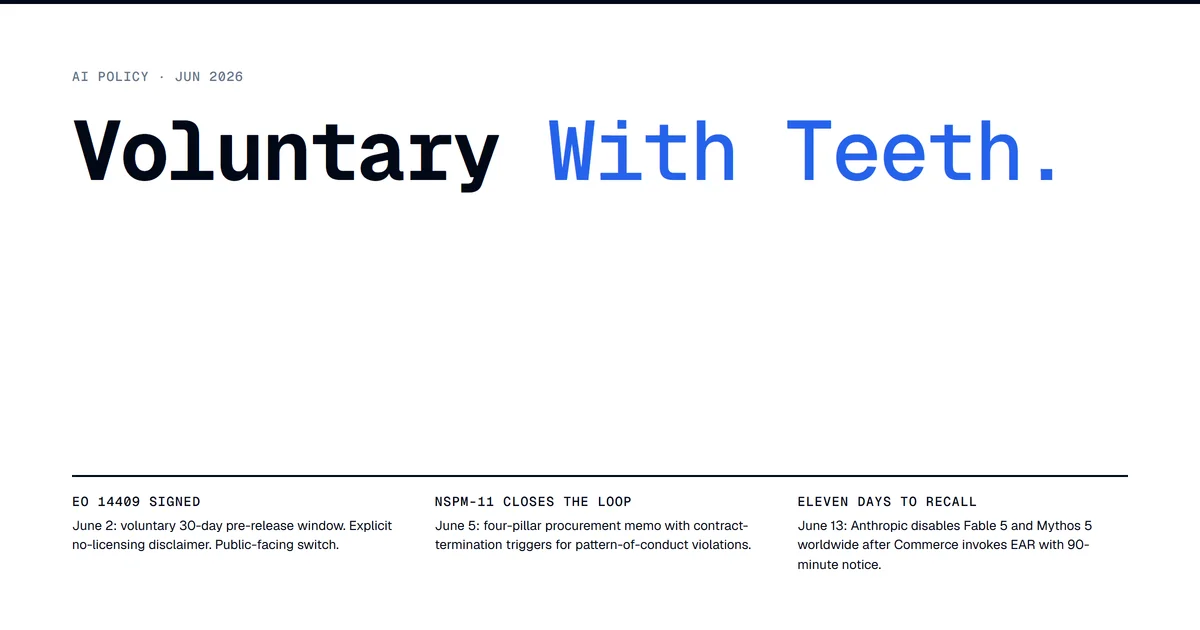
The voluntary AI framework and the export-control authority now exist as one paired regime, and the administration can switch between them at will. EO 14409 is the public-facing switch. The Export Administration Regulations are the operational one. Anthropic disabled Claude Fable 5 and Claude Mythos 5 worldwide on June 13, eleven days after the order was signed, because the second switch got flipped while the first was still being praised in the press releases.
That eleven-day gap is the artifact of the regime. The legal-press coverage of EO 14409 led, almost without exception, with the disclaimer that "nothing shall be construed to authorize creation of any mandatory governmental licensing, pre-clearance, or permitting requirement." Mayer Brown, Morrison Foerster, Snell & Wilmer, and Crowell & Moring all quoted that line in their first three paragraphs. Eleven days later, Commerce Secretary Howard Lutnick sent Dario Amodei a letter saying a special license was required to distribute Mythos 5 and Fable 5 to all destinations worldwide, and threatening "prompt criminal and civil penalties" for non-compliance.
The voluntary framework didn't fail. It worked exactly as intended. The cover story was the public artifact; the export-control letter was the enforcement artifact; both authorities existed in parallel from June 2 onward. This post walks the two-track structure, the eleven-day proof, and what it does to the cross-border AI compliance stack for anyone shipping or buying frontier models in the second half of 2026.
This is the fourth post in an arc that started May 4 with "the Mythos gate vs the DeepSeek door" (gating without statute as the diagnosis), May 11 with "The Mythos Boomerang" (the institutional substrate forming in four weeks), and May 31 with "The Boomerang Completes" (capacity and capital retiring the federal-access objection). May 31 called the boomerang landed; June 2 to June 14 is what landed looks like in motion.
What EO 14409 actually says, and what it leaves to other authorities
President Trump signed EO 14409, Promoting Advanced Artificial Intelligence Innovation and Security, on June 2, 2026. The order has three operative sections plus criminal enforcement, and the structure matters more than any single deadline.
Section 2 — federal cyber defense. By July 2, CISA must issue Binding Operational Directives accelerating cyber defense of civilian federal systems, with NSA performing the equivalent for classified systems on the same timeline. Eligible beneficiaries explicitly include rural hospitals, community banks, and local utilities per the Government Contracts Law analysis. The "voluntary industry-government clearinghouse that coordinates and deconflicts scanning for software vulnerabilities" sits inside this section, with a July 2 establishment deadline per the White House EO text.
Section 3 — secure frontier model deployment. By August 1 (60 days), NSA develops "a classified benchmarking process that assesses the cyber capabilities of AI models and sets a threshold for designating a model as a 'covered frontier model'" per Snell & Wilmer's analysis. The benchmarking criteria are classified. The designation process is classified. The NSA Director makes final designations in consultation with the National Cyber Director, OSTP, the CISA Director, and DoD representatives.
What developers get under Section 3: an option to "provide the federal government access to their model for up to 30 days before public release, and work with the government to select which partners receive early access," subject to confidentiality, cybersecurity, insider-risk, and IP protections. This is the voluntary part. CFR's Matthew Ferren on the enforcement reality: "U.S. frontier labs for AI will likely participate in the testing regime voluntarily, if only to forestall more invasive regulation later." The voluntariness is a deterrence mechanism, not a constraint mechanism.
The May 31 draft had a 90-day pre-release review window. The final June 2 order cuts it to 30 days, per the CFR assessment, which calls the reduction a competitiveness concession: the earlier version "was pulled over concerns that it would blunt U.S. labs' competitiveness with China."
Section 3, the disclaimer. The order explicitly states "nothing shall be construed to authorize creation of any mandatory governmental licensing, pre-clearance, or permitting requirement" for AI model development or distribution. This is the line that anchored almost every legal-press analysis. Read it again carefully. It limits the EO itself from being construed as creating licensing. It does not limit other authorities from being applied to the same companies for related purposes. That distinction is the load on which the eleven-day test ran.
Section 4 — criminal enforcement. The Attorney General prioritizes prosecuting AI-enabled unauthorized computer access under 18 U.S.C. §§ 1028, 1030, and 1343. Existing cybercrime statutes, not new authority.
What EO 14409 does not do: it does not preempt state law (that was the December 2025 EO 14365, with a separate AI Litigation Task Force and $42B in broadband infrastructure funding conditioned on state AI law repeal, per Crowell & Moring and Paul Hastings). It does not create statutory force; labs participate voluntarily or they don't. And it does not authorize a licensing regime. That last point is the one the Lutnick letter would test.
NSPM-11 closes the procurement side
Three days after EO 14409, on June 5, Trump signed National Security Presidential Memorandum 11, on AI in the National Security Enterprise. NSPM-11 is the procurement-side companion to the public-facing EO.
The four-pillar framework, per the White House text and Crowell & Moring's analysis:
- Adoption. Accelerate AI adoption across mission areas, maintain "deep, proactive partnerships with industry" to access cutting-edge models quickly.
- Adaptation. Adapt commercial or open-source AI technologies, leveraging "the most cutting-edge capabilities available from diverse suppliers."
- Assurance. Ensure all AI adopted is reliable, robust, steerable, and controllable, with contract language preventing any entity from disabling, degrading, or modifying these systems without authorization.
- Accountability. American AI technologies "shall neither be developed nor used by the national security enterprise to censor free speech, embed ideological bias, or conduct unauthorized or unlawful surveillance."
The deadlines compress: 90 days for the DOD Directive 3000.09 update on autonomous weapons, 120 days for procurement review, a computing-resources roadmap, AI data/model exchanges, a talent reserve, curriculum development, joint AI risk management strategy, and standardized Test/Evaluation/Verification/Validation methodologies.
The kicker is the termination clause. Per Crowell, the memo "directs termination of contracts with companies showing 'a pattern of conduct that is inconsistent with policies' outlined in the framework," with waiver exceptions limited to one year with reporting requirements. That is a contractual lever pointed at vendor behavior. Separate from EO 14409, separate from EAR, available whenever the federal customer wants to use it.
The combined picture: EO 14409 is the public-facing pre-release coordination framework. NSPM-11 is the procurement-side rulebook for how the national security enterprise buys, validates, and (when needed) terminates relationships with AI vendors. CAISI sits underneath both as the voluntary evaluation substrate that came out of the May 5 multilateral. Three layers, plus an export-control track sitting next to all of them: voluntary pre-release sharing (EO), procurement gating (NSPM-11), capability evaluation (CAISI), and EAR enforcement (Commerce).
The Fable 5 / Mythos 5 episode: 90 minutes to disable
Eleven days after EO 14409 was signed, the framework got its first operational stress test. The export-control track ran without the voluntary framework saying a word.
The timeline, reconstructed from the Inquirer's reporting and corroborated by Time, Bloomberg, and Al Jazeera:
Anthropic deployed Claude Fable 5 and Mythos 5 in early June, within less than a week of the Commerce action. Friday June 12, 1:15 PM: administration officials called Anthropic with a 90-minute deadline to disable access to advanced models, citing a national security threat. No details provided. Anthropic asked what the threat was so it could fix it. The government refused to specify. Friday June 12, 5:21 PM: Commerce Secretary Howard Lutnick sent a letter to Dario Amodei informing him that "a special license would be required to distribute Mythos and Fable 5 models to all destinations worldwide, as well as to non-U.S. citizens." The letter warned: "Failure to comply will result in prompt criminal and civil penalties, as provided for by law."
Saturday June 13. Anthropic disclosed in a blog post: "The US government, citing national security authorities, has issued an export control directive to suspend all access to Fable 5 and Mythos 5 by any foreign national, whether inside or outside the United States. To ensure compliance, we have had to abruptly disable Fable 5 and Mythos 5 for all our customers."
Sunday June 14. Anthropic flew senior technical staff to Washington to meet Commerce, CIA, and White House science advisor Michael Kratsios.
The authority cited in the Lutnick letter was pre-existing: Export Administration Regulations administered by the Bureau of Industry and Security. Not Section 3 of EO 14409. Not the CAISI voluntary framework. Not NSPM-11. The administration reached past the new public-facing infrastructure and used the old export-control authority that had been sitting there the whole time. The reported trigger was a "narrow potential jailbreak" finding from "Amazon and others" per the Axios summary captured by Kimmonismus, which Anthropic characterized as something the government had described only verbally. Anthropic disputed that a narrow jailbreak should warrant recalling a commercial model deployed to hundreds of millions of users.
The political subtext, per the same Axios reporting and the Polymarket June 15 capture: White House officials on Anthropic, "Anthropic came to every fork in the road and took the wrong fork." Behind-the-scenes framing: "Everybody said Anthropic was a bad actor. Some of us said it was time to give them a chance. Now those people are questioning that. They screwed us." That is vendor-relationship management as the determining variable, with the EAR as the legal vehicle.
Dean W. Ball's June 15 thread, now at 59,000 views from a named Mercatus analyst with policy credibility, captures the structural diagnosis:
Precisely as I predicted, the recent cyber EO, which admin officials insisted was not a licensing regime, ends up in practice being a licensing regime. Forget 'voluntary,' forget 'permissionless.' AI is licensed now, but the requirements change constantly and are always a secret, even to the administration itself, which will discover the rules spontaneously in real time as it reacts to events.
— @deanwball, June 15, 2026
That is the structural read on the eleven-day window. The voluntary framework is the cover story for the licensing regime. The licensing regime runs through EAR, not through the EO. The rules are discovered as the administration reacts to events, not published in advance. That is how a voluntary framework gets teeth without admitting it has them.
Why the two-track structure was probably the design, not the accident
Here is the part that's worth being clear on: this isn't necessarily a story about an EO being undermined by a separate agency. It's plausibly the story of an EO that was designed to give cover to an enforcement regime that was always going to use existing authority.
Read the disclaimer again: "nothing shall be construed to authorize creation of any mandatory governmental licensing, pre-clearance, or permitting requirement." If the EO had stayed silent on licensing, the legal-press coverage would have asked whether Section 3 implied a licensing power. The explicit disclaimer pre-empts that question. It lets the administration say truthfully that EO 14409 does not create licensing authority while leaving every other licensing authority that already exists fully intact.
The 30-day pre-release window in Section 3 is the same kind of structural feature. A 30-day voluntary sharing window is what a lab does when it wants to be inside the room before a release. It is also exactly long enough for Commerce, NSA, CISA, and the National Cyber Director to flag any model the administration wants to flag, well before public release. The voluntariness produces the artifact the enforcement track needs. A lab that opts out of the voluntary 30-day window is a lab that has chosen to release a model the administration has not pre-screened, which is precisely the lab the EAR enforcement track is calibrated to react to.
The signature on EO 14409 was the piece that did the structural work. Not because the EO created new authority. It explicitly didn't. The signature mattered because it created the public-facing framework that lets the administration cite "voluntary cooperation" while operationally using older authorities to compel. Without the EO, the Lutnick letter would have read as naked executive coercion. With the EO, it reads as voluntary cooperation with a parallel enforcement option running underneath. The signature bought narrative legitimacy, not legal authority.
Don't get me wrong. This is not a claim that everyone in the administration sat in a room and designed it this way. Federal AI policy is rarely that coherent. It's a claim that the regime behaves as if it was designed this way, regardless of the intentionality, and that the behavior is what binds vendors and compliance teams. The behavior reproduces the structure: public voluntariness on top, EAR enforcement underneath, switched at the administration's discretion.
The dual-stack compliance problem, made literal
The May 11 post argued US/EU directionality had flipped. The June 2 to June 14 window changes the geometry again. It is no longer that the US is strict and the EU loose. It is that the US is both formally voluntary AND operationally coercive at the same time, while the EU's Omnibus deferral keeps high-risk obligations on a 16-month delay (deadline moved from August 2, 2026 to December 2, 2027 per the May 7 trilogue covered in the May 11 post).
A cross-border AI compliance team now maintains five stacks for one model from one company:
1. US release-evaluation stack. Monitor EO 14409 implementation. By August 1, NSA's classified benchmarking criteria define what counts as a "covered frontier model." Track CAISI voluntary agreements. Track whether the 30-day pre-release window stays voluntary or evolves into a contractual requirement via FAR amendments and OMB guidance, which Snell & Wilmer flag as the likely conversion mechanism: "forthcoming Federal Acquisition Regulation (FAR) amendments and OMB guidance may convert this voluntary submission into a contractual requirement."
2. US export-control stack. Separate from EO 14409. The Lutnick letter used existing EAR authority. Any vendor selling a model the administration designates a national-security risk is on a same-day notice clock. Diligence has to include the new question: what is your continuity plan if a Commerce letter arrives with a 90-minute deadline? That question did not exist on June 11. It exists now.
3. US procurement stack (NSPM-11). If your customer is a federal national-security buyer, your contract is governed by the four-pillar framework with 120-day deadlines for joint risk management, T&E/V&V methodologies, and contract-termination triggers for "pattern of conduct inconsistent with policies."
4. State-law stack. December 2025's EO 14365 set up Commerce, FTC, and DOJ pressure on state AI laws, but state laws "will likely remain in effect even if the federal government brings suits against them" per Crowell. Tennessee SB 1493 (training-side criminal liability, July 1, 2026 effective) is still alive. California, Colorado, and others have active deployment-side rules. Federal preemption is contested, not settled.
5. EU deployment stack. Annex III high-risk AI obligations deferred to December 2, 2027. ENISA inside Glasswing (June 1) is a customer-access decision, not a regulatory one. The EU AI Office position on Mythos-class models in EU markets is still pending as of June 15.
Five stacks. One model. One company. The May 4 four-vector framework (capability tier, access regime, regulatory domicile, weight openness) still works as a diligence rubric, but the access-regime vector now reports under multiple authorities simultaneously. Anthropic just learned that lesson at the speed of a same-day Commerce letter. Every Anthropic competitor, partner, and customer just learned it secondhand.
What this changes for builders, buyers, and the next 90 days
Two practical implications fall out of the eleven-day window, and three things to watch through August.
For builders: if you are training or fine-tuning a model that has any plausible path into the covered-frontier designation, the 30-day voluntary window is no longer a choice between "share and get inside the room" and "don't share and stay out." It is a choice between "share, get inside the room, and accept that the room may decide your release date" and "don't share, stay out, and accept that the EAR enforcement track has full discretion when you ship." The voluntariness is real on its own track; the consequence of opting out is no longer voluntary on the other track.
For buyers, meaning anyone integrating a frontier model into a production system, the new diligence question is the 90-minute continuity plan. If Anthropic can lose Mythos 5 and Fable 5 for all customers worldwide on 90 minutes' notice, any vendor in the covered-frontier tier can. The continuity plan is not "switch to the next provider's frontier model" because the next provider's frontier model is one Commerce letter away from the same fate. It is "pre-architect the integration so the cyber-relevant workflows degrade gracefully to a smaller open-weight model the EAR cannot recall." That is now a Q3 2026 architecture decision, not a 2027 one.
For the next 90 days, three things to watch:
FAR amendments converting voluntary to contractual. Snell & Wilmer's forecast is the canonical one: forthcoming FAR amendments and OMB guidance will likely convert voluntary pre-release submission into a contractual requirement for federal vendors. Watch the Federal Register between July and September 2026. If they land before the August 1 NSA benchmarking deadline, the voluntariness window is shorter than the EO text suggests.
The first "covered frontier model" designation. By August 1, NSA publishes (classified) criteria. The first public designation will probably be retroactive: Mythos 5 and Fable 5 by name. Watch whether OpenAI's GPT-5.5-Cyber or any xAI/Google model gets the same treatment. The asymmetric application of the framework is the variable to watch. If only Anthropic faces the EAR enforcement layer, Dean Ball's "selective enforcement" diagnosis is confirmed and the regime is functionally a vendor-relationship-management tool dressed as an export-control regime.
Congressional response. House Science Committee Ranking Member Zoe Lofgren issued a June 14 statement objecting to the Anthropic action; whether House Science Committee Democrats can build coalition with libertarian-leaning Republicans to push back on the EAR-as-substitute-for-EO maneuver is the question for late June and July. The bipartisan coalition on AI export controls has been thin so far. The Fable 5 episode is the first event sharp enough to test whether the coalition can form around process, not policy.
The May 4 post called the gating "without statute." That diagnosis aged better than the post itself expected. EO 14409 is now the public artifact of a regime that explicitly disclaims licensing authority while operating one through EAR. The voluntary framework is the public-facing switch. The Export Administration Regulations are the operational one. Eleven days from June 2 to June 13 is what it takes for the administration to flip both, in sequence, with a company that thought it was inside the voluntary track right up until the Commerce letter arrived at 5:21 PM on a Friday.