The Mythos Gate vs the DeepSeek Door
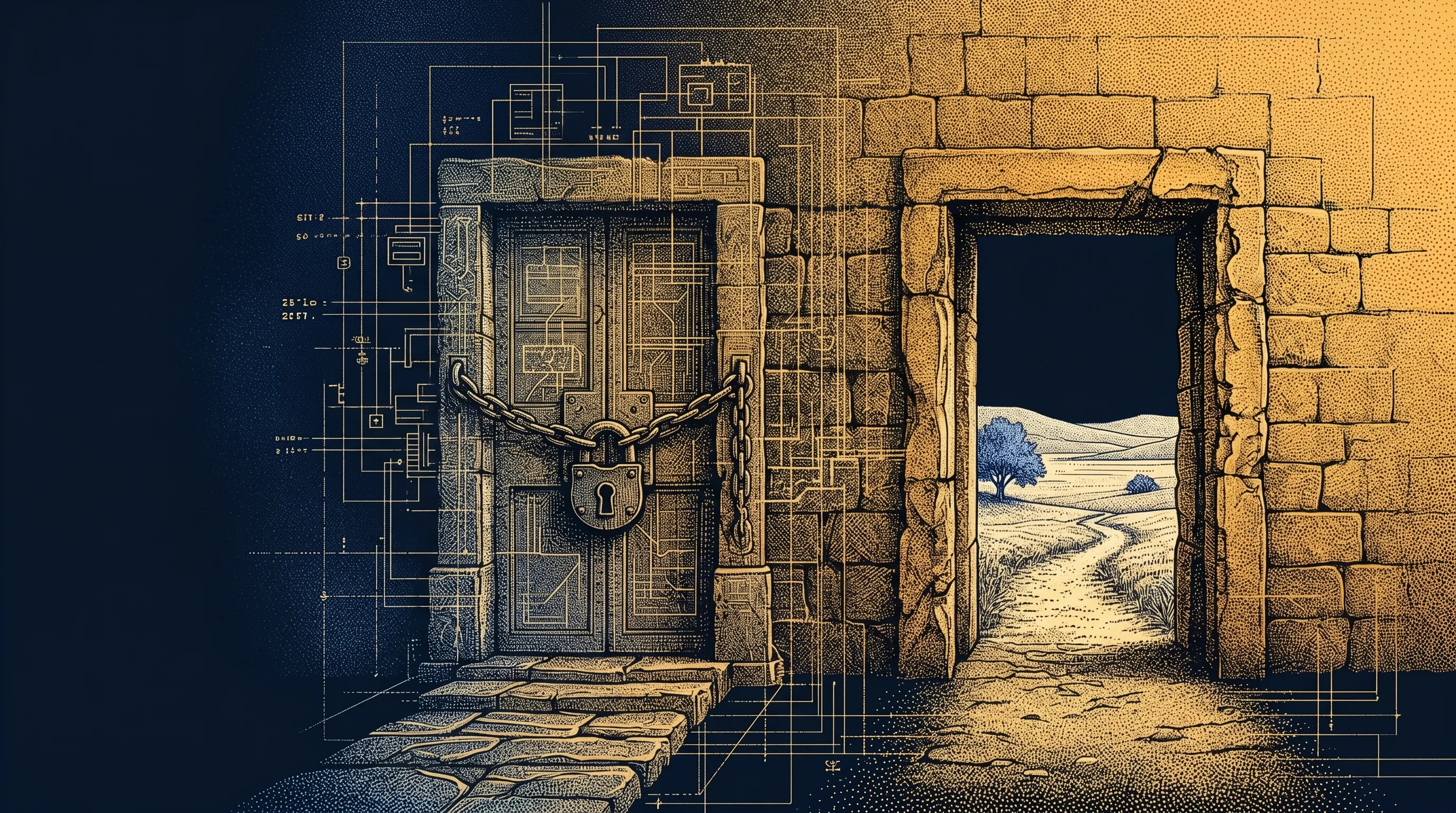
On April 30, 2026, the Wall Street Journal reported that the White House opposed Anthropic's plan to expand Project Glasswing access to Claude Mythos Preview from roughly 50 organizations to roughly 120. Six days earlier, on April 24, DeepSeek shipped V4-Pro under MIT license: 1.6 trillion total parameters, 49 billion active, a 1 million token context window, and frontier-class agentic coding performance. Penetration-testing practitioners are already evaluating it for local vulnerability discovery. Whatever access regime the US executive branch imposes on Mythos, it cannot impose on weights that are already on Hugging Face.
That asymmetry is the story. The Glasswing dispute is a real regime change in how frontier AI gets distributed inside the US. It is also operating against an open-weight reality the US no longer controls. The gate works only as long as Mythos retains a meaningful capability lead over the best open-weight alternative, and that lead is closing month by month. As a CFA charterholder who has spent 13 years building inside financial institutions where regulatory architecture and product architecture constantly collide, this is the kind of structural mismatch I was trained to flag. The gating is enforceable. The asymmetry is not.
What Actually Happened on April 30
Anthropic launched Project Glasswing on April 7, 2026, as a coordinated cybersecurity initiative pairing Claude Mythos Preview (an unreleased frontier model) with eleven named launch partners and roughly 40 additional critical-infrastructure organizations. The named partners: AWS, Apple, Broadcom, Cisco, CrowdStrike, Google, JPMorganChase, the Linux Foundation, Microsoft, NVIDIA, and Palo Alto Networks. Anthropic committed up to $100 million in Mythos Preview usage credits across the program, plus $4 million in donations to OSS security organizations. Post-preview pricing was disclosed at $25 per million input tokens and $125 per million output tokens, roughly an order of magnitude above flagship Claude pricing.
The capability claims are unusually concrete. Anthropic's April 7 red-team write-up reports that Mythos identified and exploited zero-days in every major operating system and every major web browser, including a 27-year-old OpenBSD TCP SACK flaw, a 16-year-old FFmpeg H.264 codec vulnerability, and a 17-year-old FreeBSD NFS RCE (CVE-2026-4747). On OSS-Fuzz across roughly 7,000 entry points in 1,000 repositories, Mythos produced 595 crashes at tiers 1 and 2 versus 150 to 175 for Sonnet and Opus. On a Firefox exploit-chain benchmark where Opus 4.6 had a near-zero success rate, Mythos succeeded 181 times. Over 99 percent of vulnerabilities found remain unpatched, which is why most findings are undisclosed. These are vendor self-reports, not yet third-party replicated, but concrete enough to take seriously.
In mid-to-late April, Anthropic proposed expanding Glasswing membership by roughly 70 additional organizations, taking the total to about 120. The Wall Street Journal broke the story on April 30, picked up by Bloomberg the same day. Polymarket led with the compute angle: "White House reportedly opposes Anthropic's plan to expand preview access to Mythos over fears it lacks the compute to do so without affecting government use."
Two reasons were given. The first is a national security argument: Mythos is described in Anthropic's own materials and in WSJ reporting as powerful enough to enable dangerous cyberattacks, and wider access (even to corporate users) was flagged as a misuse concern. The second gets less press attention: the White House told Anthropic the company does not have enough compute to serve 120 enterprises without degrading federal access. The NSA is among the federal agencies currently using Mythos. Anthropic's reported $900B+ fundraising consideration is in part to secure infrastructure capacity for Mythos at scale.
These are not the same kind of objection. The first is a capability-tier argument that maps onto existing dual-use export-control reasoning. The second is the executive branch acting as a customer who does not want their service degraded.
What DeepSeek Did Six Days Earlier
DeepSeek released V4-Pro and V4-Flash on April 24, 2026, under MIT license. V4-Pro is 1.6T total parameters with 49B active per token. V4-Flash is 284B total with 13B active. Both ship a 1M-token context window with up to 384K-token output. The weights are on Hugging Face. Anyone with the bandwidth can download them. Anyone with the GPUs can run them.
The capability gap matters here. On the LM Arena Elo leaderboard as of March 2026, DeepSeek (1424) sits in the same top tier as Anthropic (1503), xAI (1495), Google (1494), OpenAI (1481), and Alibaba (1449). The headline gap to the frontier is roughly 80 Elo points and shrinking. On cyber-specific tasks the gap to Mythos is real but not categorical. A Penligent practitioner assessment describes V4-Pro as promising for local vulnerability discovery because it is a strong long-context coding and agentic model with open weights, while noting that it still needs a security-specific scaffold around it.
The asymmetry, stated cleanly:
| Side | Top model | Access regime | Geographic limits | Cyber capability tier |
|---|---|---|---|---|
| US | Claude Mythos Preview | Vendor-hosted, ~50 vetted orgs, federal access prioritized, expansion to 120 blocked April 30 | Enforceable (closed weights) | Frontier, vendor-self-reported on OSS-Fuzz and exploit-chain benchmarks |
| China | DeepSeek V4-Pro | MIT license, weights on Hugging Face | None | Sub-frontier on cyber-specific evals, frontier-class on long-context coding and agents |
The Mythos gating is enforceable only as long as two things hold: Mythos retains a meaningful capability lead over the best open-weight alternative, and the executive branch is willing to keep applying informal pressure. Both have shorter half-lives than the analogous nuclear and chemical-weapons regimes. The Atomic Energy Act has 70 years of statutory infrastructure behind it. The Mythos gate has a phone call from the Chief of Staff.
What Statute, Exactly?
There is none. That is the point.
The January 2025 BIS rule established ECCN 4E091 for closed-source AI model weights trained on more than 10^26 operations and made license applications to non-allied destinations presumptively denied. BIS estimated fewer than five models globally exceeded that threshold. The Trump administration rescinded the broader Biden-era AI Diffusion Rule in May 2025 before it took full effect.
The Glasswing dispute does not invoke ECCN 4E091. It is a domestic-access dispute, not an export-control one. Anthropic was proposing to grant access to US companies, not foreign nationals. The mechanism is closer to three other levers operating in parallel:
Informal pressure leverage from concurrent disputes. In February 2026, Defense Secretary Pete Hegseth designated Anthropic a supply chain risk, the first American company to receive a designation historically reserved for foreign adversaries, over disagreements about military use terms including Anthropic's refusal to allow mass surveillance use or fully autonomous weapons. Anthropic sued in March; a federal judge granted a preliminary injunction; the appeals court declined to pause the designation in April. A company in active litigation with the federal government over one set of contracts is differently positioned to refuse informal opposition on another.
National security framing as a non-statutory veto. The White House did not issue an order. It expressed opposition. Anthropic did not announce non-expansion as a result of legal compulsion. It announced nothing and declined to comment. The expansion did not happen.
Compute-customer leverage. The federal government as a current Mythos user has the implicit ability to argue that broader commercial access would degrade its own service, regardless of the cybersecurity framing. Pentagon CTO Emil Michael told CNBC on May 1 that Anthropic remains designated a supply chain risk while framing Mythos itself as a separate national security moment. Chief of Staff Susie Wiles met Anthropic CEO Dario Amodei at the White House on April 17 to discuss Mythos directly.
The cleanest framing: Mythos gating is the company-level analogue of the BIS Entity List. The Entity List works because compliance is enforced through banking and supplier relationships, not because the underlying transactions are illegal. The Mythos gate works because Anthropic has reason to maintain a working relationship with the executive branch, not because expansion would violate any rule. The pre-2000 ITAR regime around strong cryptography is the historical parallel that didn't last once the underlying capability was math that could be freely published. Mythos differs because it gates access to a hosted model, not algorithms, which makes it actually enforceable while the model stays closed-weight.
Why Open Weights Break the Gate
Closed-weight gating is real engineering. The model lives on Anthropic's infrastructure. Access is API-keyed. Misuse is logged. Anthropic can revoke any customer's access in seconds. Whatever capability gap Mythos has on the cyber tasks Anthropic chose to disclose is a gap the US can keep behind a customer list.
Open weights inherit none of that. Once weights ship under MIT license, the only enforcement is jurisdictional, and jurisdiction stops at the network boundary. No logs, no revocation, no central point of failure to negotiate with. Running V4-Pro at scale needs serious infrastructure (1.6T total parameters), but penetration-testing teams running local pipelines do not need scale. They need a model running on a single high-memory node against a defined target. V4-Pro's 1M-token context window holds the source tree of a mid-sized codebase. That is the working surface a human security researcher uses.
The capability gap is the variable that determines how much the gate matters. If Mythos is 10x better than V4-Pro at autonomous vulnerability discovery, the gate buys time. If Mythos is 1.5x better, the gate is mostly symbolic. The vendor-self-reported gap on OSS-Fuzz (595 crashes versus 150 to 175 for Sonnet and Opus) is real but is not a comparison against V4-Pro. Nobody has published that comparison yet. The first independent benchmark will tell us what the gate is actually buying.
The nuclear non-proliferation analogy gets cited a lot. As one Reddit thread put it: "at what point does frontier LLMs access look more like export-controlled military hardware than software?" The structural similarity is real. A private actor produces a capability the executive branch deems too dangerous for general distribution and gates it via case-by-case sign-off. The legal architecture is not. Atomic Energy Act controls are statutory. Mythos gating is a phone call. Nuclear material is physical and traceable. Model weights are math and copyable. The dual-use framing borrowed from the nuclear regime brings the seriousness without the enforcement infrastructure.
The Compliance Stack Underneath All of This
The Mythos news lands during an active reset of model-risk regulation in the US, the EU, and at the state level. Three changes within a 90-day window matter.
SR 11-7 to SR 26-2 (US, effective April 17, 2026). The Federal Reserve, FDIC, and OCC rescinded SR 11-7 on April 17 and replaced it with SR 26-2, a more risk-based, principles-driven framework for model risk management. SR 26-2 reaffirms the third-party model rule: institutions using vendor AI models (fintech, open-source, or hosted frontier) must apply the same MRM standards as internally developed models. Generative and agentic AI were explicitly excluded from the new framework's scope as novel and rapidly evolving, with a separate request for information forthcoming.
The relevant implication: JPMorganChase is a named Glasswing launch partner. JPM is also an SR-26-2-supervised institution. Their use of a frontier model whose access is gated by informal executive-branch sign-off is a model-risk-governance event the new rule does not cleanly cover. The model they validate is no longer just the weights. It is the access regime under which those weights are reachable. I spent 9 years at SmartBiz Loans building credit risk and BI under SR 11-7. From the inside, the model was always a stable artifact you could version, validate, and lock down. Once the model itself is hosted by a vendor whose customer list is dynamic and partially set by government opposition, the validation framework has a hole the rule doesn't name.
EU AI Act high-risk effective date (August 2, 2026). High-risk AI obligations under Articles 9 to 17 (provider) and Article 26 (deployer) become enforceable August 2, 2026. The European Commission proposed on November 19, 2025 to defer the deadline to December 2, 2027 via the Digital AI Omnibus, but the second political trilogue on April 28, 2026 ended without agreement. If the Omnibus is not adopted before August 2, the original timeline applies.
For Glasswing-tier enterprise users with EU operations, the access-regime question intersects with EU AI Act Article 15 robustness and cybersecurity requirements. A high-risk AI system whose vendor is operating under informal executive-branch access constraints raises a documentation question the regulation did not anticipate.
Tennessee SB 1493 (effective July 1, 2026). Tennessee's SB 1493 creates Class A felony liability (15 to 25 year sentences) for knowingly training AI to provide emotional support, develop relationships, simulate humans, or encourage suicide or criminal homicide. Civil cause of action with $150,000 liquidated damages plus punitive available. Tennessee's bill is on a different axis (training rather than access), but it lands during the same window. More state-level bills will follow.
Combined enterprise posture for the next 12 months has to assume the model your vendor sells you today may not be the model your vendor can sell you next quarter, the customer list of your vendor's most capable model is now a regulated artifact, SR 26-2 puts third-party AI oversight back in the bank's lap without specifying how to validate a dynamic access regime, the EU's August 2, 2026 high-risk date holds, and state-level criminal-liability vectors are non-uniform across the US.
That is compliance limbo. From the Mythos r/Futurology thread: "Anthropic just decided the NSA gets their best model but CISA doesn't. Who draws that line going forward?" The answer the post is reaching for: nobody, on paper. The executive branch, in practice.
A Four-Vector Diligence Framework for Buyers
The Mythos episode forces a more specific vendor diligence framework than the one most procurement teams currently run. Four vectors:
Capability tier. What is the model rated for, and what is the next tier behind it? If your vendor sells you a model at capability tier N, you want to know what the best open-weight alternative at tier N or N-1 looks like. That is your continuity option if vendor access changes. For frontier-cyber capability, V4-Pro is now the floor. Any procurement that does not name an open-weight fallback is a hope, not a procurement.
Access regime. Is access governed by published terms, by published terms plus informal executive-branch oversight, or by neither? Mythos shows that published terms alone are no longer sufficient diligence. You need to know whether the customer list itself is something the executive branch has opinions about. If it is, your access is downstream of a relationship you are not party to.
Regulatory domicile. Where is the model trained, hosted, and accessed from? US-trained, US-hosted, US-accessed sits cleanly under SR 26-2 and ECCN 4E091. EU-accessed adds Article 15. EU-deployed adds Article 26. Tennessee SB 1493 adds a state-level training-liability vector.
Weight openness. Closed-weight, partially-open, or fully-open under permissive license. The Mythos episode makes this variable load-bearing. Closed-weight vendors can have their access regime constrained by informal pressure. Open-weight vendors structurally cannot.
These four vectors define a posture. A regulated bank running JPM-tier compliance on a US-hosted closed-weight frontier model has a different risk profile than a Singapore fintech running an open-weight model on local infrastructure. Both are valid postures. Neither is risk-free. The framework's job is making the trade-offs explicit before something breaks.
The 12-Month Forecast
A formal BIS or EAR rule naming cyber-capability tiers as a controlled commodity is plausible by end of 2026 but not certain. ECCN 4E091 took 18 months from concept to rule. A cyber-capability-tier rule starts from a less mature framework and faces a harder definition problem.
The company-by-company, capability-by-capability negotiation pattern continues regardless. Project Glasswing is the template. Expect at least two more analogous fights in the next 12 months: one on agentic autonomy, one on bio capability. The mechanics will look similar. National security framing layered on compute-customer leverage layered on an existing dispute. The companies decline to comment. The expansions do not happen.
Open-weight catch-up continues independently. DeepSeek V4-Pro is six days old when WSJ breaks the Mythos story. V5 is presumably under training. Alibaba, Tencent, and Baichuan are all training frontier-class models. The cyber-specific gap is closing through scaffold engineering even where the base model gap is not. The realistic window for the Mythos gate to do meaningful work is measured in months.
The sovereignty framing is going to compound. From r/Btechtards: "We don't have a serious AI ecosystem and now our Govt has to beg Frontier AI labs for access for safety of sensitive infrastructure in the country." Every country outside the US-allies tier reads the Mythos gate as a sovereignty problem and reads V4-Pro as the answer. That shows up in procurement, in research partnerships, and eventually in policy.
The Builder's Calculus
The macro picture is one thing. If you are building on top of frontier AI, the operational picture is more specific.
If you need cyber capability today and you have the clearance plus the relationships, Mythos through Glasswing is the best tool available. That tool's customer list is now an artifact of executive-branch attention, which means your access is downstream of a political process you do not control.
If you need cyber capability today and you do not have the clearance, V4-Pro is the floor. Stand up a high-memory inference node, build the security-specific scaffold around it, and close the capability gap with prompting, tool integration, and evaluation harnesses. Most of that work transfers to whatever you upgrade to next.
If you are buying frontier AI for an enterprise workload, run the four-vector diligence on every vendor. Particularly check whether your vendor's top-model customer list has been the subject of executive-branch communication in the past 90 days. If you can't answer that, your diligence picture is incomplete.
The Mythos gate works inside the United States. The DeepSeek door is already open everywhere else. The half-life on that distinction is the variable everything else turns on.
Research compiled May 2026. Primary sourcing: WSJ via Bloomberg, Anthropic /glasswing, Anthropic Red, CNBC, CBS News, OCC Bulletin 2026-13, European Commission, National Law Review, and the DeepSeek V4-Pro release page on Hugging Face. Mythos cyber benchmark numbers are vendor self-reports and have not been third-party replicated as of publication.