Same Score, a Third of the Hardware: Muse Spark Open vs DeepSeek V4.1 Flash on Mac Studio
Meta's 816-billion-parameter Muse Spark Open runs on two Mac Studios at about 25 tokens a second. That's a real result and the best local AI demo of the month. It's also the wrong box to buy.
Muse Spark Open, released October 15, needs about 493GB of memory at 4-bit, so it takes two M5 Ultra Mac Studios with 512GB each. Apple's benchmark puts the pair at 24.99 tokens a second for one user at an 8,192-token context. DeepSeek V4.1 Flash fits on a single 256GB M5 Ultra that costs $9,499, and it scores the same on the Artificial Analysis Intelligence Index: 39 for each. In my 24/7 cost model, that one Mac costs about $304 a month to own and run. The same tokens on DeepSeek's own API cost about $278 at peak prices. No local rig I've priced has come that close to its own API.
In February I priced a ten-card RTX 5090 cluster against the API and called it a passion project: about $1,500 a month in hardware and power to save $220 of API spend. I re-ran that math with October hardware. The verdict moved, and it moved toward the smaller box.
What two Mac Studios deliver running Muse Spark Open
About 25 tokens a second, for one person at a time, at an 8K context. That's the whole published result so far.
Muse Spark Open has 816 billion total parameters and 42 billion active per token, with a 1M-token context window (Meta). Meta tuned it for two M5 Ultra Mac Studios, and Apple's MLX team published the numbers the same week (Apple ML Research). At NVFP4, a 4-bit format, the weights take about 493GB.
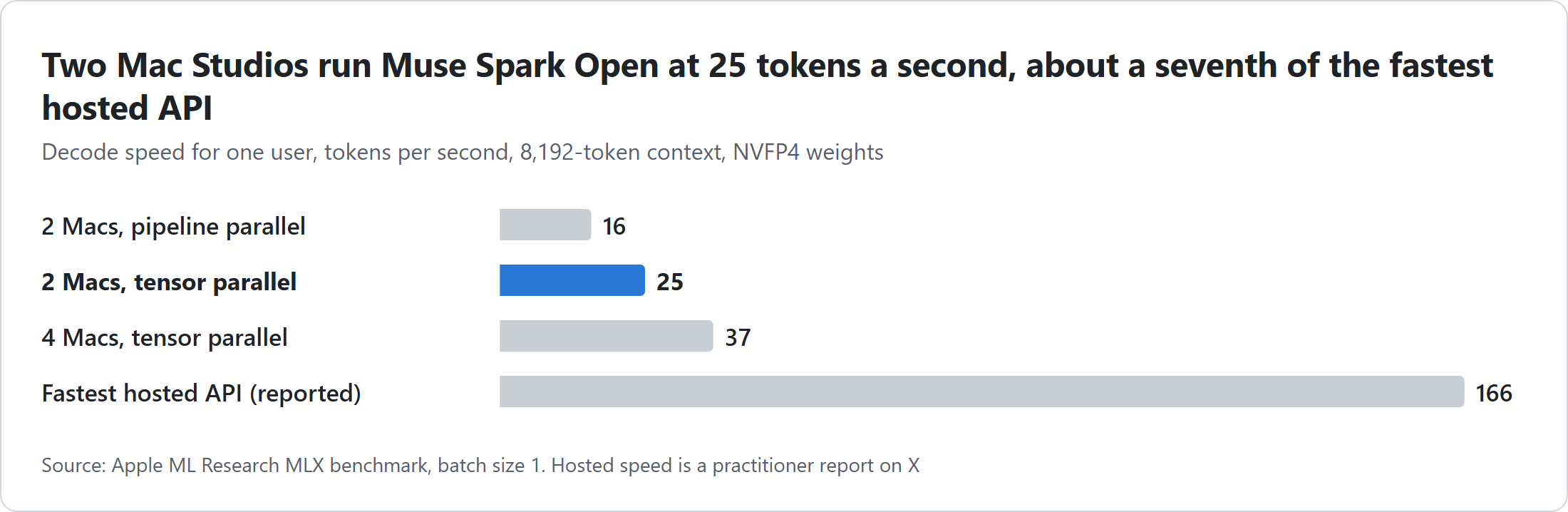
The gap between the first two rows comes down to how you split the model. Pipeline parallelism gives each Mac half the layers, so every token walks through Mac one and then Mac two. Tensor parallelism splits every layer in half, so both machines work on each token at the same time. That only pays off with a fast link between them, which Apple got from a new Thunderbolt 5 driver in macOS 26.2. On two machines it's worth 59%. Doubling to four Macs buys 47% more speed for twice the hardware.
Now the fine print. Every Apple number is batch size 1 at 8,192 tokens. Apple also published results at a 65,536-token context, including its prompt-reading times, but some of those rows match the 8K rows exactly, which looks like a page error. I'm leaving all the 65K numbers out, and that means there's no published 8K prompt-reading time for the Mac pair. Nobody has published multi-user numbers for Muse on Macs. One Hacker News commenter put it plainly:
"15-36 tokens/second is for a 8,192 token context. That's not nearly enough context to be useful." Hacker News, Oct 2026
For comparison, practitioners report the fastest hosted Muse providers at roughly 166 to 190 tokens a second per user. That's about 7x the Mac pair. Local wins the network round trip and loses on generation speed by close to an order of magnitude, the same trade I described in February.
Speed is only half the bill, though. The other half is a price Apple hasn't published.
How much do two 512GB M5 Ultra Mac Studios cost?
Nobody knows yet. Apple hasn't priced the 512GB M5 Ultra, and the ship date depends on who you read: "late October" per iClarified, "later this month" per MacRumors, "end of the year" per MacStories.
Here's what is priced. The M5 Ultra Mac Studio starts at $5,499, and the jump from 96GB to 256GB of memory is $4,000, so a 256GB box is $9,499 (Macworld, Implicator). The last 512GB Mac, the M3 Ultra, cost $9,499 with a 1TB drive. Apple pulled that option in March over DRAM supply (9to5Mac). If memory was scarce enough to kill the last 512GB model, I'd expect the new one to cost more.
So the two-Mac figure in this post is my estimate: $24,000 to $32,000 for the pair, with $28,000 as the midpoint. Every two-Mac number below inherits that guess. If Apple prices the 512GB model at the low end, the Muse rig gets about 13% cheaper. That narrows the gap with Muse's own API. Against DeepSeek's API, the pair still costs several times as much.
Which model matches Muse Spark Open on one Mac Studio?
DeepSeek V4.1 Flash. Artificial Analysis scores it 39 on its Intelligence Index at the Max setting, and 40 in its max-effort reasoning mode (Artificial Analysis). Muse Spark Open also scores 39 (Artificial Analysis). One index is one lens, so read that as a tie on general capability. Your own workload could still split them. Neither tops the open-weight table, either. Muse ranks 10th, and one post on X puts GLM-5.3 at 45 and Kimi K3 at 44 (@ce_sun94161).
The reason DeepSeek fits on one box is how it stores its weights. It uses about 16 billion active parameters per token when generating, and its full checkpoint is 510GB. Part of that is a set of lookup tables DeepSeek calls Engram, and local setups keep about 150 to 200GB in memory while parking about 189GB of those tables on the SSD (ModemGuides). That's how it squeezes into 256GB. The price is slower prompt reading, because some of the model lives on a drive. It's also MIT-licensed, while Muse ships under a Meta license with limited commercial terms.
On speed, MindStudio measured DeepSeek V4 Flash on a 256GB M5 Ultra at 40 tokens a second in llama.cpp and 53 in MLX. It held 66 tokens a second in total across four users and 46 across eight (MindStudio). That test ran the earlier V4 Flash. The one-Mac numbers in this post assume V4.1 runs about the same, which is my assumption.
Here's where my first pass went wrong. I started with a Hacker News report of a single 256GB Mac reading prompts at about 3,200 tokens a second. With that number, the one-Mac rig beat DeepSeek's API outright. MindStudio's measured 32K-token prompt took 44 to 50 seconds, which works out to roughly 700 tokens a second, more than four times slower. One forum comment against a measured benchmark isn't close, so the model below uses MindStudio, and the one-Mac rig lands just short of the API.
So one Mac runs a model with the same score at nearly twice the generation speed of the Muse pair, serves a handful of users, and costs about a third of my estimate for two 512GB Macs.
The break-even math: one Mac, two Macs, or the API
This section is my own model, built from the numbers above. I made it the best case for local on purpose:
- Workload: a 24/7 agent loop. Every call is 8,192 tokens in and 1,000 out, run back to back with no idle time.
- Depreciation: 36 months, straight line, with nothing left at the end. That's harsher than reality for a Mac, and I picked it on purpose. If local still wins under it, the result holds up.
- Power: Apple's stated peak of "300W for the Mac Studio with M5 Ultra" (Apple ML Research), around the clock at the EIA's 2026 US residential average of 18.2 cents per kWh (EIA).
- API prices: list prices with no cache hits. Muse on OpenRouter is $1.25 per million input tokens and $4.25 per million output (OpenRouter). Artificial Analysis lists the same price. DeepSeek V4.1 Flash is $0.30 in and $1.20 out at peak, half that off-peak (DataStudios).
Walk the two rigs through it.
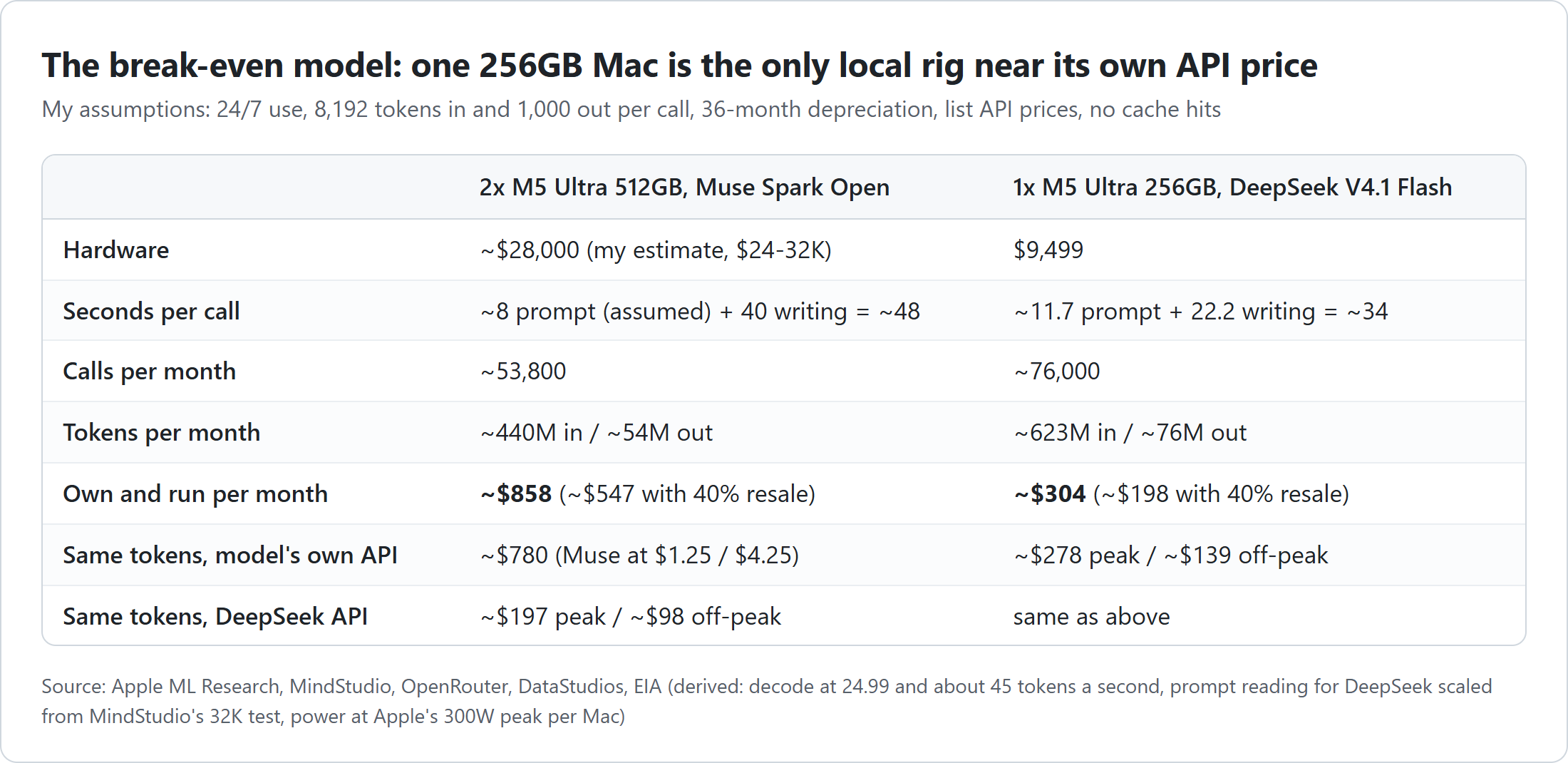
Two Macs running Muse. Each call takes about 48 seconds: about 8 to read the prompt, which is my assumption since Apple didn't publish one at 8K, and 40 to write 1,000 tokens at 24.99 a second. That's about 53,800 calls a month, or 440 million tokens in and 54 million out. Owning the pair costs about $778 a month in depreciation plus about $79 in power, about $858 in total. The same tokens on Muse's OpenRouter price cost about $780. If the pair reads prompts much faster than I assumed, it fits in more calls, and at near-zero prompt time those tokens would be worth about $940 on the API. So call it parity, give or take 10%.
One Mac running DeepSeek. Each call takes about 34 seconds: about 11.7 to read the prompt and 22.2 to write 1,000 tokens at about 45 a second. That's about 76,000 calls a month, or 623 million tokens in and 76 million out. Owning it costs about $264 in depreciation plus $39 in power, about $304 in total. The same tokens on DeepSeek's API cost about $278 at peak and $139 off-peak.
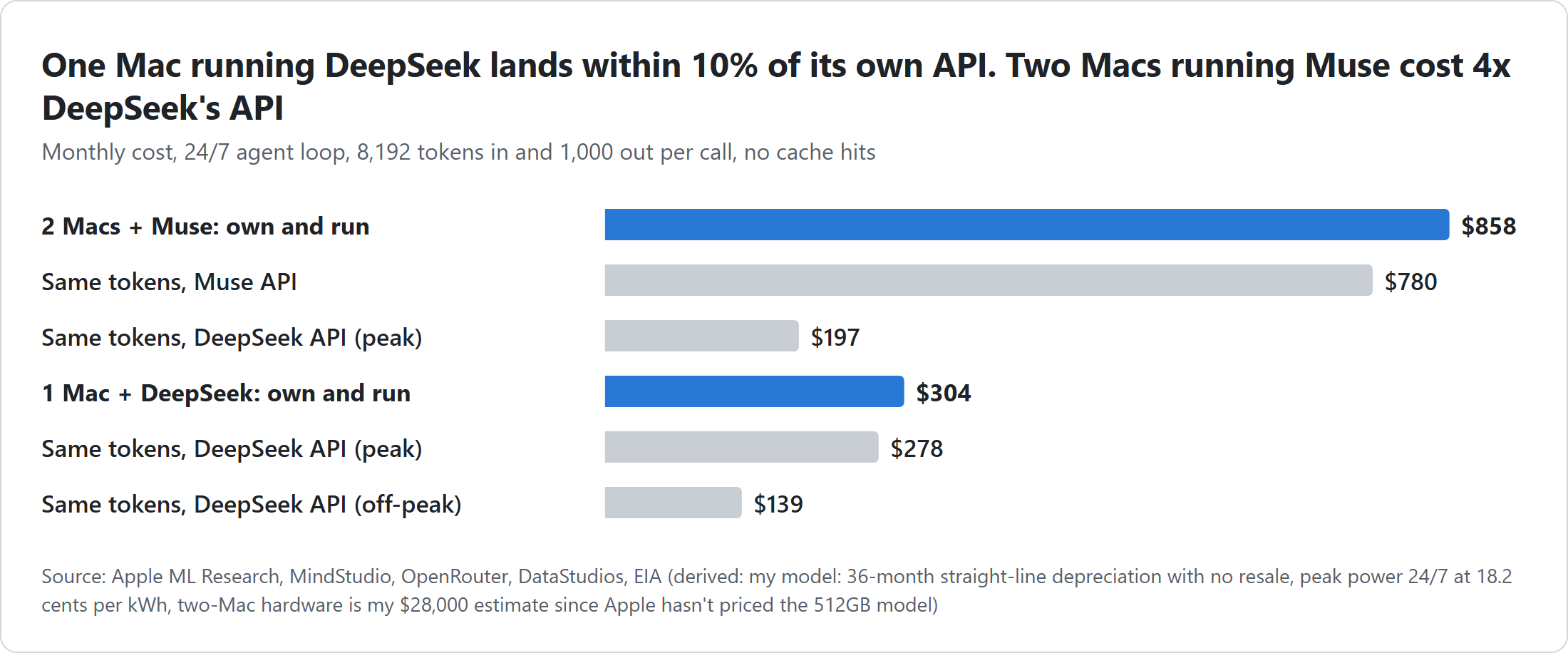
Three things fall out of that chart.
- The Muse pair is close to its own API price. About $858 against $780 to $940 is a real change from February, when the 5090 cluster cost about seven times the API spend it replaced.
- The Muse pair loses badly to a cheaper model. Run its 440 million input tokens through DeepSeek's API and the bill is about $197 at peak, or $98 off-peak. That's a quarter to an eighth of the cost of owning the Macs, for a model with about the same score.
- One Mac lands within about 10% of DeepSeek's peak price. If the box still sells for 40% of its price after three years, my assumption since I haven't researched Mac resale, the monthly cost drops to about $198 and beats peak pricing. It still loses to off-peak pricing.
Caching makes the API side cheaper still. DeepSeek charges $0.003 to $0.006 per million input tokens on a cache hit, about 2% of the normal price. An agent that re-sends the same system prompt and tool list on every call gets that discount on a big share of its input, and no local box can match it.
A skeptic on X ran a simpler version and got a harsher answer:
"Two M5 Ultras is roughly $21K before tax, and at $4.25 per million output tokens the API break-even is something like 6 years." @aleckloss, Oct 2026
He counted output tokens only and used 256GB pricing. Agent loops read far more than they write, so counting input as well brings the pair much closer to parity. It still doesn't get there.
Utilization decides whether local AI hardware pays off
Everything above assumes the box never stops. Picture your own loop. If it runs during working hours and sleeps overnight, call that 50% use, and every local number doubles per token. The one Mac still costs about $304 a month, but now it replaces only $70 to $139 of API tokens.
You can't fix that by adding users, because these machines don't batch well. The 256GB Mac peaked at 66 tokens a second in total at four users and fell to 46 at eight. A rack of datacenter GPUs gets cheaper per token as more requests share it. A Mac Studio mostly doesn't.
So the buyer test is simple. Can you keep one model busy around the clock on work you'd otherwise pay for? If the honest answer is a few hours a day, the API wins at any of these prices.
Where the RTX 5090 and DGX Spark land in October
Both got worse for this job since February.
RTX 5090. The list price is still $1,999. The best September resale price was $4,795, about 2.4 times list, and new cards on Amazon ran $5,258 (GPUPoet). The cheapest listing GPUPoet tracks this month is $6,033. February's cluster assumed $3,200 a card. At $4,795, the same ten cards cost about $48,000 for the GPUs alone, and their 320GB still can't hold Muse at 4-bit. A leaker claimed Nvidia is moving the 5090's chip supply to its pricier RTX Pro line (Notebookcheck), and Micro Center lists several models as no longer carried. Nvidia hasn't announced an end to the card, and an Nvidia executive was reported as saying it's still shipping. Until Nvidia says otherwise, this is a supply squeeze, and a painful one.
DGX Spark. Nvidia's 128GB box costs $4,699 after a $700 increase in February (Toolhalla). Two of them run Muse Spark Open, but only on a 1-bit quantized copy at about 7 tokens a second. The tester who ran it, @wei_wang, calls it fit for batch jobs only and stays on GLM-5.3-Flash at 62.2 tokens a second for chat and coding. On models that fit, though, two Sparks read long prompts 2.5 to 3 times faster than the Mac. A 32K-token prompt took about 17 seconds on the pair against 44 to 50 on one M5 Ultra (MindStudio). An agent that re-reads a big context on every call might be better off there.
Used V100s. A 32GB card sells for about $695 on eBay, and one widely shared post says the market is "suddenly flooded" (@unbug). That's a good deal for a 30B-class model. Holding Muse's 493GB takes 16 of them plus the servers to host them.
When the two-Mac Muse Spark rig still makes sense
The two-Mac pair has a real job. It fits a short list of buyers.
- Data that can't leave the building, at frontier scale. For the first time a model this size runs on hardware that sits on a desk and draws about 600W. The alternative used to be a datacenter node. Mistral Large 4 at 4-bit, for example, needs a full 8xH200 server (Yotta Labs).
- Long batch jobs with no rate limits. If it runs overnight and nobody waits on it, 25 tokens a second is fine.
- A hedge on API prices. H100 rental prices are climbing again after falling through 2025 (IntuitionLabs). Owning the hardware locks in your cost per token. You pay a premium for that insurance.
- A US-lab model on-prem. If your procurement team rules out Chinese-origin weights, DeepSeek is off the list and Muse is one of the few options at this size. I priced what that rule costs in the provenance premium post.
The Hacker News crowd was blunter. The top reply said Muse underperforms "Qwen3.8 Flash Next and GLM 5.3 Flash, both of which you can run on a single B300." Another summed up the whole setup:
"Meta will spend millions/billions on building open-weight models and then people will send Apple $20,000 to run them." Hacker News, Oct 2026
Should You Buy?
If you need Muse specifically, or you need a model this size on your own premises, wait two things out. Apple has to price the 512GB Mac, and someone has to publish Muse numbers with more than one user and more than 8K of context. Until then, rent.
If you do buy now, buy the one Mac and point it at DeepSeek. That's the version of this demo that comes closest to paying for itself for now.