Procurement Inversion III: The Provenance Premium on Western Open Weights

Banks, insurers and hospitals can now put a near-top AI model on their shortlist that they can run on their own servers and that no Chinese lab built.
This matters because until now those buyers had two bad options. Run Chinese weights and fight the compliance review, or drop to Llama 4 or Gemma 4, a full capability tier down. Most shops took the second and moved on. A real option in between turns "no Chinese models" from a hard veto into a trade-off you can price, and every team that self-hosts AI now has to decide, workload by workload, what that trade-off is worth.
That trade-off has a price, and it now has a name: the provenance premium. Mistral Large 4, the best open-weight model built outside China, sits about 7 points below the top Chinese models on the Artificial Analysis Intelligence Index. The rest of this post works out what those 7 points cost, and when they're worth paying.
This is part three of a series. In May, the procurement inversion argued that DeepSeek weights in your own VPC had become the low-friction path for some internal workloads, and that regulated shops should fall back to Llama 4, Gemma 4, or Command A. In June, MiniMax M3 put a doorman on that door with a revenue-threshold license and a datacenter hardware floor. October adds a second door. It's Western, it's close to the frontier, and it charges a toll.
What Mistral and Reflection Actually Announced
Two Western labs announced open-weight models at the 0.5T to 1T scale in the first week of October. You can't download either one yet.
Mistral Large 4 arrived as a preview on October 6. It's 1T total parameters with about 50B active per token. Mistral's launch page says 52B, while Implicator and other outlets report 49B. API pricing is $1.36 per million input tokens and $4.18 per million output. Euronews reports the weights are due October 27, and Mistral hasn't said what license they'll ship under. Artificial Analysis lists the model as proprietary until they land.
That missing license could change the whole buying decision. Large 3 shipped under Apache 2.0. Medium 3.5 used a modified MIT license that excluded companies with more than $20 million in monthly revenue from free commercial use (Trending Topics). Those are two very different procurement conversations.
Reflection Beam was announced on October 5. It's 501B total with 23B active, and Reflection says the weights ship under Apache 2.0 "later in October" (runtimewire). The API is waitlist-only with no public price, and every benchmark so far is Reflection's own. Its charts put Beam at 65.5 on SWE-bench Pro, behind Qwen3.8 Max at 67.7 (eesel.ai).
Both labs are selling origin first. Mistral's pitch is European training, European serving, European law:
"If you use a closed model, there is no guarantee it will still be there tomorrow."
Guillaume Lample, Mistral co-founder, via Implicator, October 2026
Reflection's pitch is blunter. CEO Misha Laskin points to demand "from organizations that want sovereign AI systems and do not want to rely on Chinese models." The skeptics were just as blunt:
"Reflection's new US-made open weight model is worse than every major Chinese model. ... This is like congratulating yourself for becoming the US national Mahjong champion."
Haseeb Qureshi (@hosseeb), October 2026
Where Mistral Large 4 Ranks on the Artificial Analysis Index
Mistral Large 4 is the best non-Chinese open-weight model on the Artificial Analysis Intelligence Index, and it ranks 8th among open weights overall. The index rolls 10 evaluations, including Humanity's Last Exam, SciCode and Terminal-Bench, into one score across reasoning, knowledge, math and programming (Artificial Analysis methodology).
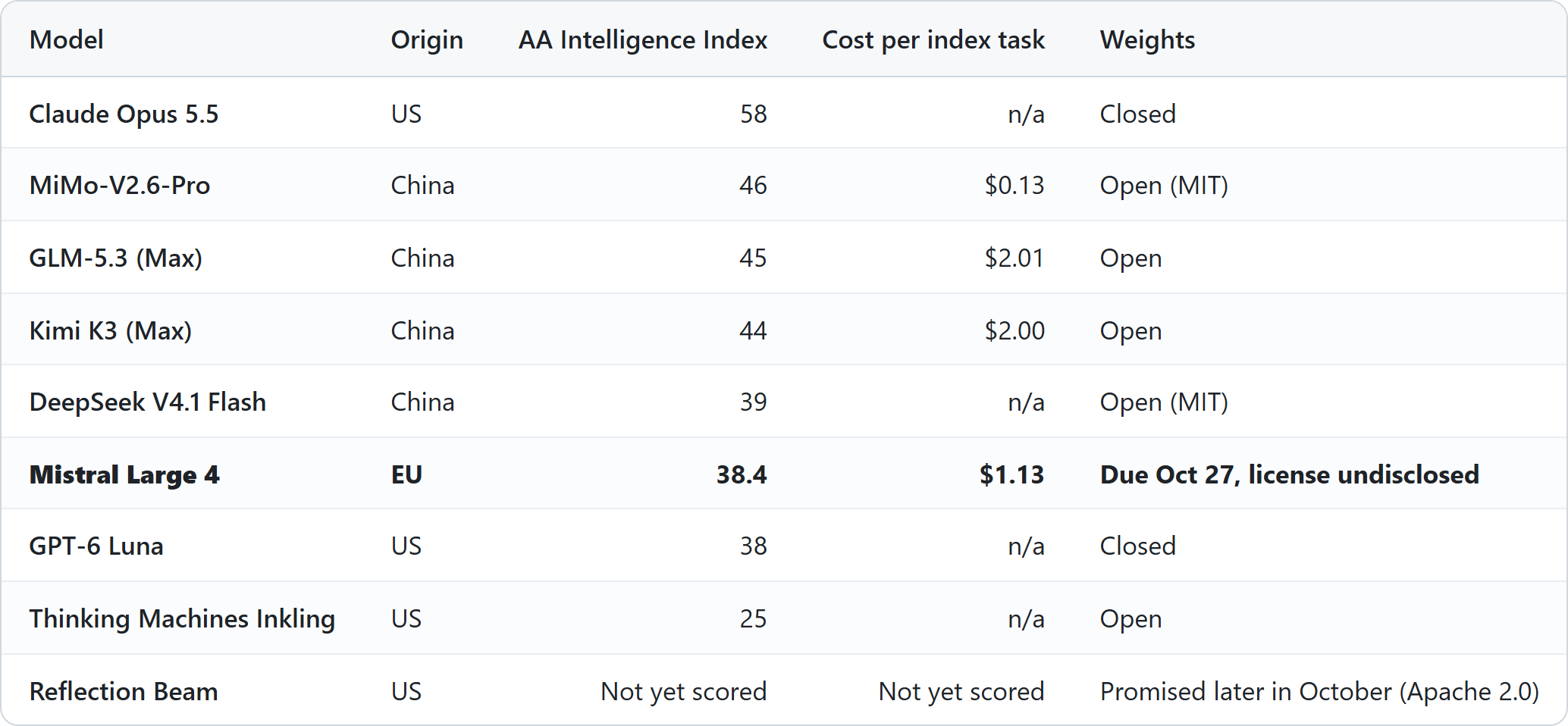
Three numbers from that chart stuck with me:
- It ties GPT-6 Luna, OpenAI's cheap closed tier, at 38.
- The best US open-weight model before this month was Thinking Machines' Inkling at 25, so the Western open tier jumped about 13 points in a week.
- The gap to the Chinese leader is still 7.6 points, and Opus 5.5 sits about 20 points above Large 4.
Practitioner tests land in the same place. Pawel Huryn ran his 105 replanted-bug test, and Large 4 averaged 15 against 25.7 for Qwen 3.8 Max.
"It's not the best, the cheapest, or the fastest. It just is - an European model."
Pawel Huryn (@PawelHuryn), October 2026
To be fair, there's a version of this launch that looks great. Plotly's chriddyp reported a jump from 58% to 74% on a data-analytics benchmark against Mistral Medium 3.5, at 10x lower cost. If you're already a Mistral customer, Large 4 is a real upgrade. The premium only shows up when you put it next to the Chinese open models.
The Provenance Premium, in Numbers
Choosing the best Western open weights over the best Chinese ones costs about 7 index points. The cost per task depends on which Chinese model you compare against. I went in expecting the cost line to be the second half of the premium, and the numbers on Artificial Analysis didn't cooperate.
- Capability. 38.4 against MiMo-V2.6-Pro at 46, GLM-5.3 at 45, and Kimi K3 at 44. That's a 5.6 to 7.6 point gap. Even DeepSeek V4.1 Flash, a speed tier, edges it at 39.
- Cost against MiMo. $1.13 per index task for Large 4 against $0.13 for MiMo-V2.6-Pro. That's roughly 9x the spend for 7.6 fewer points.
- Cost against GLM and Kimi. GLM-5.3 runs about $2.01 per task and Kimi K3 about $2.00 in their Max configurations. Against those two, Large 4 is the cheaper model per task and still 5.6 to 6.6 points behind.
- Tokens. Large 4 generated 200M output tokens across the index run, against an 82M median. GLM-5.3 generated 210M and Kimi K3 160M, so heavy output is a trait of this whole tier.
Self-hosting doesn't make the token line go away. GPU hours scale with tokens generated, so a model that writes 2.4x the median output burns about 2.4x the serving time on your own hardware too.
So the premium has one fixed part and one variable part. The fixed part is capability, about 7 points, whichever Chinese model you'd otherwise pick. The variable part is cost: steep if MiMo was your alternative, negative if GLM-5.3 or Kimi K3 was.
Why would anyone pay any of this for weights that run on their own machines? Part 1 made the case that weights in your own VPC don't phone home. One developer put it more bluntly this month: "the model stops being Chinese the second it's on your machine" (@kirillk_web3). That holds for data residency. It doesn't settle behavior trained into the weights. VentureBeat reported that DeepSeek-R1 wrote about 50% more security-flawed code when prompts touched Chinese political triggers, and that behavior travels with the file wherever you run it.
Until this month, pointing at a model's Chinese origin worked as a veto. Saying no to Chinese weights meant dropping to Llama 4 or Gemma 4, a whole capability tier down, and the conversation usually ended there. Now there's a real alternative one step down, and the veto turns into a line item.
Here's the worksheet I'd run for each workload. It comes down to three numbers and one question.
- Capability gap. How far behind the Chinese alternative is Mistral Large 4 on the index? Against MiMo it's 46 minus 38.4, about 7.6 points.
- Cost ratio. What does Large 4 cost per task next to the alternative? Against MiMo it's $1.13 against $0.13, about 8.7 times as much. Against GLM-5.3 it's $1.13 against $2.01, so Large 4 is the cheaper one, at a little over half the cost.
- Hardware floor. How big are the Western model's weights at 4-bit? About 525GB, enough to fill one server with eight H200 GPUs.
Then the question: does a provenance review, or how the model handles refusals, decide the deal? If it does, pay the premium, as long as the capability gap doesn't break the task. If it doesn't, send the workload to the cheapest model that passes your own evals.
Take one workload and walk it through. A security team wants an on-prem model for general software work and security tooling. The data can't leave the building, and the buyer's policy rules out Chinese-origin weights. Keep that team in mind.
Buyers Are Already Trading in Both Directions
That security team isn't hypothetical. Buyers are writing this exact spec right now: one H200-class card for general software work and security tooling, no Chinese-origin weights, including the Chinese base models that sit underneath many popular fine-tunes, and a preference for labs in NATO countries.
Some of them say outright that they know the Chinese models are ahead and are ruling them out anyway. That's a buyer paying the premium with eyes open.
Other buyers are going the other way. Ecosia, the European search engine with a mission-driven brand, dropped Mistral and is looking at Qwen, GLM and Kimi through the hosting platform Melious. In an October 6 Politico interview, founder Christian Kroll called Mistral "a year behind" (PPC Land):
"We've roughly cut our costs in half while improving quality and performance."
Christian Kroll, Ecosia, October 2026
That's the premium being declined by the kind of buyer you'd expect to pay it. The volume data leans the same way. 7 of the top 8 open models by OpenRouter usage are Chinese (@richardturrin), and Interconnects lists Harvey, Cursor, DoorDash, Airbnb and Perplexity among US companies already running Chinese open weights.
No Law Is Forcing the Choice Yet
The US has enacted no new rule against Chinese open weights in the last 90 days. For now, the premium is a policy each buyer sets for itself.
- The House Homeland Security and Select China committees weighed procurement bans and sent letters to Cursor and Airbnb in July (AI Weekly).
- The White House's August framework exempts open-weight models, Chinese ones included, from government testing (Bloomberg Government).
- The China FIREWALL Act of 2026 (HR 10670), introduced October 1, would ban government procurement of Chinese AI models. It's sitting in committee (FastDemocracy).
A voluntary premium is a negotiable one. A company can pay it on the security stack and decline it on the marketing-copy pipeline in the same quarter. If HR 10670 or something like it passes, the premium becomes mandatory for every buyer it covers overnight, and Mistral and Reflection get pricing power they don't have today.
Where the Premium Buys Something: Cyber Refusals
Back to the security team. On the CyberGym-E2E vulnerability-reproduction benchmark, Mistral Large 4 completed 81.7% of tasks, the best of 18 models tested. GPT-6 Astra refused 100% of them and Opus 5.5 refused 98.5% (ActuIA).
The Chinese open models aren't behind here. MiMo-V2.6-Pro ties for the lead on the Artificial Analysis Cyber Index at 56, where Large 4 scores 49.5. But this team ruled them out on origin. The frontier APIs refuse the work, and the stronger open models fail the spec. That leaves Large 4 as the model that both does the task and clears provenance review. For this workload, the premium is the price of having an option at all.
The Hardware Floor: About 525GB Before You Serve a Token
Self-hosting either model is datacenter work. Mistral Large 4 at 4-bit is about 525GB of weights, and Yotta Labs says to plan for about 630GB. That fits one 8xH200 node (1,128GB) or a 4xB300 tray. FP8 is about 1.05TB and needs 8xB200.
Beam is the lighter lift. FP8 is about 501GB and 4-bit lands around 250 to 290GB (oflight). With 23B active and an official NVFP4 checkpoint promised, Beam is the easier one to put on your own cluster, if its vendor numbers survive independent testing.
Here's where the security team's plan breaks. One H200 has 141GB. Neither Western model fits on it at any quantization anyone has published. A buyer with that spec can price the premium all day and still needs a bigger box, or a smaller model, to pay it.
For a single builder the math is simpler. A 24GB consumer card holds about 1/22 of the 4-bit Large 4 file, so outside a datacenter this model lives behind an API no matter what license it ships under.
What to Do Before the Weights Ship
Mistral's weights and license are due October 27 (Euronews; Mistral itself says "by the end of the month"). Until then, price the premium per workload and hold the procurement call. When the weights land, read the license first, then check Beam's first independent score.
- Solo builder. The premium is pure cost for you. Route to whatever passes your eval cheapest. On Artificial Analysis's numbers, that's MiMo.
- Small team. Same routing, but keep Large 4 in the table as an exit option. As one developer put it: "Open weights are not a deployment plan. They are an exit clause."
- Regulated enterprise. This is the first time you can self-host near-frontier without Chinese weights. Write the premium down per workload and pay it where provenance review or refusal behavior decides the deal.
In May, the compliant path was Chinese weights in your own VPC. In June, that door got a doorman. In October, a Western door opened next to it, and it charges about 7 index points. Re-price that toll whenever the leaderboard moves.