The Procurement Inversion Takes a Paper Cut
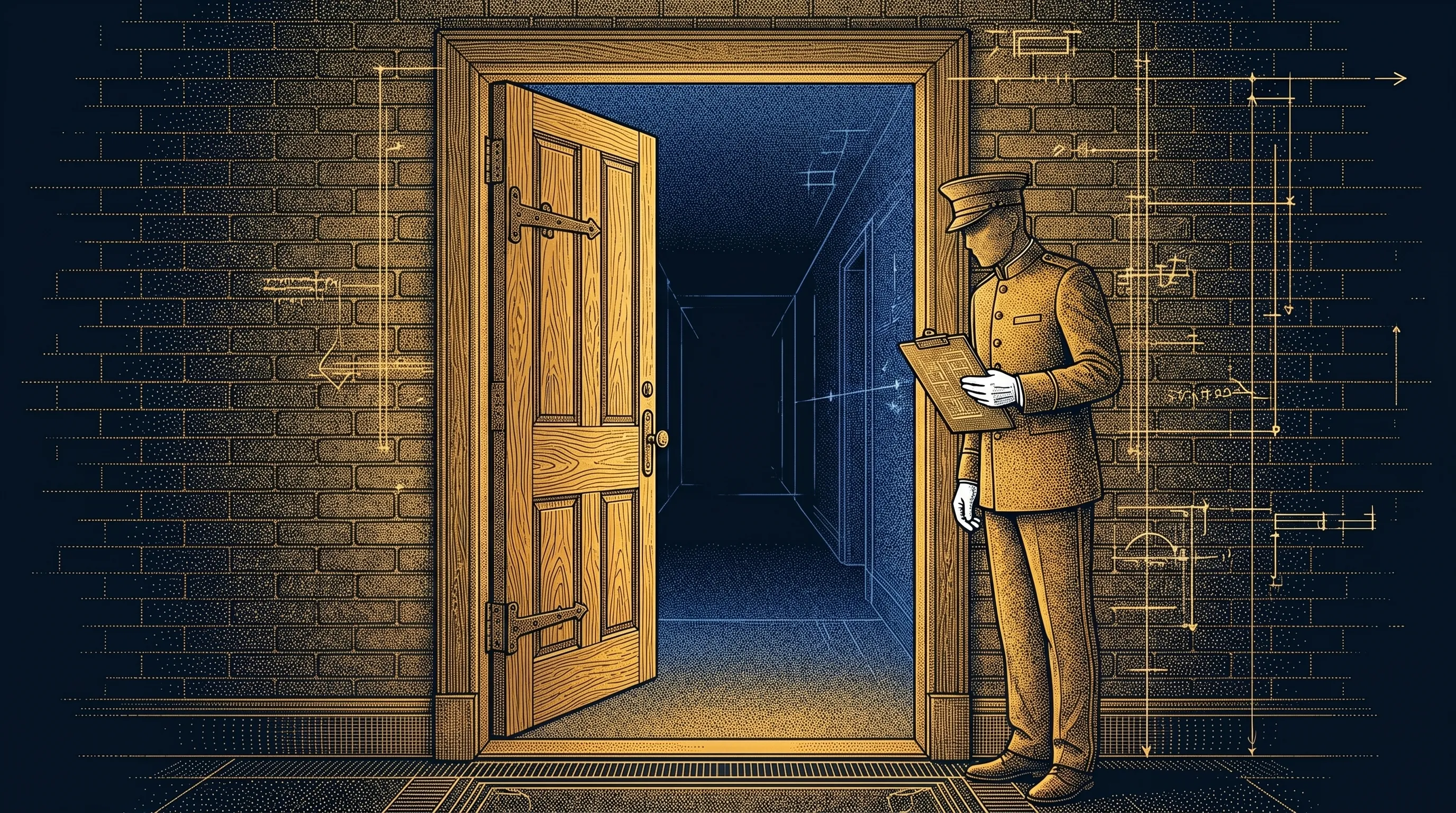
The open-weight procurement door is still open in June 2026, but MiniMax M3 just put a doorman in front of it. The model ships first-of-its-kind capabilities (frontier coding, 1M context, native multimodality in a single artifact) under the MiniMax Community License, with a $20M revenue threshold, a "Built with MiniMax M3" attribution clause, and a hardware floor that starts at datacenter-class memory. The May 7 procurement-inversion piece said the door was open. This one says it has a doorman, and the doorman has a clipboard.
MiniMax M3 hit 59.0% on SWE-Bench Pro on June 1, 2026 (MiniMax blog). That is the #1 open-weight score on that benchmark, narrowly ahead of GPT-5.5 at 58.6% and behind Opus 4.7 at 64.3%. About 428B total parameters with 23B active per token — a mixture-of-experts (MoE) layout where only a small slice of the model fires per token, which is why a 428B model can serve at near-mid-tier cost. The new sparse attention mechanism delivers roughly 1/20th the per-token compute at 1M context vs M2. The headline output price is 21× cheaper than Opus 4.7. The headline cache price loses to DeepSeek V4-Pro by about 17×. Both are true at the same time and both belong in the procurement spreadsheet.
What Actually Shipped on June 1
The architecture write-up is in the HuggingFace model card and the MiniMax launch blog. About 428B total parameters with about 23B active per token, MoE, native 1M context, 512K max output, and a proprietary attention scheme MiniMax calls Sparse Attention (MSA — selectively attends to a subset of past tokens at long context rather than every token, which is how the per-token compute drops 20× at 1M vs M2's dense attention). Inputs are text, image, and video; output is text. Desktop computer-use is documented as part of the multimodal surface. Reported prefill speedups vs M2 at 1M context are ~9.7× and decode ~15.6× (HN discussion).
The headline benchmark scores from MiniMax's own numbers:
| Benchmark | MiniMax M3 | Opus 4.7 | GPT-5.5 |
|---|---|---|---|
| SWE-Bench Pro | 59.0% | 64.3% | 58.6% |
| Terminal-Bench 2.1 | 66.0% | not listed | not listed |
| MCP Atlas | 74.2% | not listed | not listed |
| BrowseComp | 83.5 | 79.3 | not listed |
Two things to flag immediately. First, SWE-Bench Pro is the contamination-resistant variant, not SWE-Bench Verified. Some second-tier coverage at launch quoted 80%+ scores for M3 by silently swapping in Verified numbers when comparing to Pro numbers from other labs. DeepSeek V4-Pro is 55.4% on Pro and 80.6% on Verified (docsbot.ai head-to-head). The 59.0 number is the right one to carry. Anyone quoting M3 above 70% on coding is comparing apples to a different fruit.
Second, the independent verification is solid. Artificial Analysis ranked M3 #1 of 165 evaluated models on its Intelligence Index at 55, with a Coding Index of 47.1 — narrowly edging DeepSeek V4-Pro by 0.4 points (heyrobinai summary). The model is verbose during eval (91M tokens generated) and slow at 58.1 tok/sec throughput (#101/165 on speed). M3 is in the top-tier open-weight basket alongside DeepSeek V4-Pro, Kimi K2.6, and GLM 5.1/5.2, not above it on every axis.
The License Is Not MIT
This is the biggest delta from the May 7 piece. DeepSeek V4-Pro shipped MIT-clean. The MiniMax Community License does not.
Read the actual LICENSE file on HuggingFace before invoking the procurement-inversion frame on this model. The terms in brief:
- Default grant: non-commercial use only.
- Commercial threshold A: yearly revenue ≤ $20M USD requires a one-time notice to
api@minimax.iowith subject "M3 licensing — notice." - Commercial threshold B: yearly revenue > $20M USD requires prior written authorization from MiniMax.
- Attribution requirement: prominent "Built with MiniMax M3" on websites, UI, blog posts, about pages, product docs.
- Sublicensing and derivatives: permitted, but derivatives carry the same terms forward.
- Prohibited uses: military, content harming minors, disinformation, discrimination, hate speech.
For a solo builder running internal tooling, the $20M threshold is irrelevant and the notice is a one-time email. For a small team shipping a product, the attribution requirement is a 6-character footer string and the notice is a calendar reminder. For an enterprise above $20M ARR, it is a procurement-and-legal conversation with a Chinese lab, and that conversation has not happened at any scale yet so there is no playbook to copy.
The HuggingFace community thread thanked MiniMax for improving the license over an earlier draft. That detail is worth carrying — the lab is responsive to community pressure on the license terms, which suggests the terms can move further. But "responsive to pressure" is not the same as "MIT," and the May 7 narrative ("Beijing-trained weights are the procurement-clean default") does not hold for M3 the way it held for DS4-Pro. The procurement door is still open. The doorman is asking for a license check.
The cross-reference matters for the comparison stack. DeepSeek V4-Pro: MIT, no threshold, no attribution. Kimi K2.6: modified MIT. MiniMax M3: Community License with revenue threshold + attribution. The license layer is no longer flat across the top-tier open-weight basket. It has gradations, and procurement teams now have to read them.
The Hardware Floor Moved Up
The May 7 piece's self-host pitch for solo builders was DS4-Flash on a 96GB workstation. M3 does not have a workstation-tier story.
Pull the Unsloth GGUF quants page and the ToolHalla VRAM analysis and the floor becomes legible:
| Quant | Disk | RAM/VRAM needed |
|---|---|---|
| UD-IQ1_M (smallest) | 128 GB | ~133 GB incl. context |
| UD-IQ3_XXS (recommended) | 159 GB | 170-200 GB |
| Q4 | 220-250 GB | 250+ |
| Q5 | 280-310 GB | 310+ |
| Q8 | 430-450 GB | 450+ |
Practitioner setups in the wild: 5-bit M3 on a single Apple M3 Ultra 512GB (HF discussion), and Q4 via MLX-VLM doing document/form-filling work at about 31 seconds per job (atomic_chat_hq). Q4 at 250GB of RAM is not a 24GB consumer GPU story. It is a $5-9K Apple Silicon story, a multi-H200 / 8× RTX 6000 cluster story, or a rented datacenter story. The 24GB-VRAM home-lab tier that ran Gemma 4 26B-A4B comfortably will not run any useful M3 quant at all.
Run that against the May 7 stack and the gap is real. DS4-Flash at FP4 fits on a single H200 at 158GB and ran on a 2× RTX 6000 workstation at the $15-20K hardware tier. M3 Q4 starts at 250GB of RAM and the recommended UD-IQ3_XXS quant wants 170-200GB. For a solo builder asking "can I run this at home" the May answer was "yes, on a workstation." The June answer for M3 specifically is "no, run it via API or rent a datacenter slice."
For my own setup, this lands as a routing decision rather than a hardware purchase decision. I am not buying a Mac Studio M3 Ultra to run a 5-bit MiniMax quant when M3 via OpenRouter costs $0.30/$1.20 per million tokens promo, $0.60/$2.40 standard. The break-even math from the May 7 piece (about 10M tokens/day before self-host beats API at this hardware tier) gets worse, not better, because the hardware tier got more expensive.
DeepSeek Wins the Cache Comparison
The pricing comparison is where M3 separates from the May 7 narrative most cleanly. The headline numbers from OpenRouter and the MaxForAI pricing thread:
| Model | Input ($/1M) | Output ($/1M) | Cache ($/1M) |
|---|---|---|---|
| Opus 4.7 | $5.00 | $25.00 | not flat |
| MiniMax M3 (≤512K, promo) | $0.30 | $1.20 | ~$0.59 |
| MiniMax M3 (≤512K, standard) | $0.60 | $2.40 | ~$0.59 |
| DeepSeek V4-Pro | ~$0.43 | ~$0.87 | ~$0.035 |
M3 output vs Opus 4.7 output is a 21× spread. That is the right headline number for this post. Not the 89× DS-Flash-vs-Opus number from May 7. M3 is a different basket than Flash. Importing the May 7 spread wholesale would mislead the cost story.
The cache comparison is where M3 loses. M3 cache pricing is approximately ¥0.42 per million cached tokens (roughly $0.059 at ¥7.1/USD). DeepSeek V4-Pro cache is approximately ¥0.025 (~$0.0035) — about 17× cheaper. For agent workloads where the same system prompt or retrieval prefix is re-sent on every call (most agent loops do this), the cache line is the dominant cost line, not the input or output line. The MaxForAI thread breaks the comparison down further: at the 512K-1M context tier, DeepSeek wins on input, output, AND cache. M3 wins the ≤512K standard-tier output comparison and loses everything else to DeepSeek.
This is the part of the spreadsheet a "MiniMax is the new cost leader" tweet skips. The promo pricing through June 15 looks dominant; the post-promo pricing is competitive; the cache pricing is not. For a builder routing high-volume agent workloads, DeepSeek V4-Pro is still the price-per-effective-token leader by a wide margin. M3 wins on capability axes where DeepSeek does not compete on the same surface: multimodal, 1M context, sparse attention throughput at long context.
"MiniMax M3 matched Claude Opus 4.8 on a code audit for $0.07" — ryanmerket, r/opencodeCLI, June 2026 (thread)
That is the practitioner-cost compression on a single task. It is anecdotal (one Reddit comment, no reproducible benchmark), but the dollar figure is consistent with M3's pricing math on a 50K-100K-token coding task with modest cache reuse. Take it as a directional signal, not a benchmark.
The Tier 2 Vendor Adoption Pattern
The May 7 piece flagged the Michaelzsguo ANTHROPIC_BASE_URL env-var swap as the harness-portability story for DS4. Six weeks later, that story is no longer a story. It is infrastructure.
MiniMax shipped M3 with documented integration paths for seven coding tools in the first two weeks (MiniMax AI coding tools doc, setup guide):
| Tool | Integration mode | Notes |
|---|---|---|
| OpenCode | OpenAI-compatible base URL | Native, free tier supports M3 |
| Cursor | Anthropic-compatible (/anthropic) | Cursor Pro required |
| Claude Code | Anthropic SDK via env vars | Drop-in ANTHROPIC_BASE_URL swap |
| TRAE | OpenAI-compatible base URL | — |
| Zed | Anthropic-compatible via settings.json | — |
| Kilo Code | Anthropic-compatible | Free tier |
| Cline | Anthropic-compatible via extension panel | — |
The pattern is the open-router IDE-extension / CLI tier (Cline, Kilo, OpenCode, Aider, Continue) converging on Anthropic-base-URL-swap as the standard model-router interface. M3 documented that path day-one. The closed-router tier (Cursor, Windsurf, GitHub Copilot Workspace) is either paywalling the integration (Cursor Pro) or not exposing it at all.
The caveat I want explicit because the May 7 narrative was loose on this point: Aider, Continue, Windsurf, and GitHub Copilot Workspace do not have first-party MiniMax integration docs. Aider and Continue both accept arbitrary OpenAI-compatible endpoints, so user-configuration works in practice. Windsurf and Copilot Workspace are closed-router products where the model list is the product surface — they will not route M3 unless they choose to ship that as a feature. A "seven tools shipped M3 integration" claim is true for the seven in the table. It is not true for the broader vendor field.
For my own routing, this lands as a Cline-and-OpenCode story. I am not paying for Cursor Pro to access an open-weight model that runs free via Cline with the same env-var swap. The closed-router tier is paywalling integration with an artifact whose weights are downloadable from HuggingFace. That gap is the leading indicator of which Tier 2 vendor catches the workload-routing tailwind and which gets disintermediated by it.
Rate limits at the API level are 200 RPM and 10M TPM, account-level across all tools. One MiniMax API key works simultaneously in OpenCode + Cursor + Cline + Claude Code, with the rate limit shared across all four. For Claude Code specifically, the swap is ANTHROPIC_BASE_URL=https://api.minimax.io/anthropic ANTHROPIC_API_KEY=$MINIMAX_KEY claude — no fork, no patched binary. Roo Code was discontinued on May 15, 2026 with migration to Kilo Code recommended. That is the kind of vendor-shuffle detail that disappears from launch coverage and matters for builders six months in.
What the Practitioners Are Actually Saying
The reception is genuinely split. Three positive switching reports:
- "MiniMax M3 matched Claude Opus 4.8 on a code audit for $0.07" — ryanmerket, r/opencodeCLI, June 2026 (thread)
- "Blew my mind... ai code reviewers like zenbot and codex bot almost never find anything to improve" — Nisam_robot, r/vibecoding, June 2026 (thread)
- "Extremely impressed with MiniMax M3... my new favorite model" — gameguy56, r/opencode, June 2026 (thread)
And three negative or mixed reads:
- "M3 is a huge letdown compared to M2.7... new quota limits killed the value proposition" — viky_shetye, r/MiniMax_AI, June 2026 (thread)
- "M3 ranks roughly #10-15 globally [vs GLM 5.2 at #5-10]" — 0xTodd, 72K followers, June 2026 (tweet)
- "M3 underperformance was a major narrative loss... GLM is seeing larger adoption with every new release" — zephyr_z9, 154K followers, June 2026 (tweet)
Both reads are real. The positive reports come from open-source-IDE-extension users who care about cost-per-task on coding workloads. The negative reads come from quant-trade-adjacent accounts comparing M3 to GLM 5.2 on a broader capability surface. The two audiences are not evaluating the same thing.
A separate Reddit observation worth flagging carefully is that practitioners on r/LocalLLaMA reported M3 "appears to have no political censorship" (thread). This is unverified. DeepSeek had documented Chinese-political-trigger code-quality degradation per VentureBeat; no equivalent test exists for M3 yet. If the observation holds under structured testing, that is a meaningful procurement differentiator. If it doesn't hold, the "self-hosted Chinese weights have political-trigger artifacts" concern from the May 7 piece carries forward unchanged. Treat as practitioner claim, not as fact.
The stock-market sidelong read: MiniMax HK at ¥1,350亿 vs Zhipu (GLM) at ¥6,500亿 as of June 15. The narrative-quant trade is reading M3 as a consumer/retail-token play and GLM as a to-B enterprise play. That is the financial-press version of the same workload-routing question. Different audience, same question, narrower vocabulary.
What the Procurement Story Actually Becomes
Stack the May 7 frame against the June frame and the shape sharpens.
May 7: the open-weight procurement vector flipped because DeepSeek V4-Pro shipped MIT-licensed at frontier-adjacent capability with a hosted-vs-weights distinction that compliance teams could draw cleanly. The path of least friction for some internal coding workloads became Beijing-trained weights in a Western VPC, not a US-hosted frontier API behind White House gating.
June 19: that vector is still flipped. M3 is still procurement-distinct from the hosted MiniMax API, the same way DS4 was. But the artifact-level terms got harder. License has a revenue threshold and attribution. Hardware floor moved up. Cache pricing is worse than DeepSeek. The decision is more granular than it was six weeks ago.
For a solo builder, the calculus is unchanged in direction, sharper in detail. M3 via OpenRouter at $0.30/$1.20 is operationally cheaper than DS4-Pro for output-heavy workloads with low cache reuse, and the 1M context plus multimodal surface opens workloads DS4 doesn't. Route through OpenCode or Cline. Send the licensing notice email. Move on.
For a small team running shared dev infra at the 96GB-workstation tier, M3 self-host is off the table. DS4-Flash stays as the self-host coding default. It actually fits the hardware. M3 enters the routing table as an API-only option for long-context multimodal coding tasks DS4 doesn't compete on. Two open-weight artifacts for two workload classes, both procurement-distinct from the hosted service surface.
For a regulated enterprise above $20M ARR, the M3 procurement conversation has not happened yet at any scale. The license is the friction. The attribution clause is awkward on internal tooling but workable. The $20M-threshold written-authorization requirement is a contract negotiation with a Chinese lab, and that procurement playbook does not exist in most enterprise legal departments today. DeepSeek's MIT removes this friction entirely for the same workload class. For now, M3 reads as a solo-and-small-team artifact, not an enterprise procurement artifact, regardless of the capability win on SWE-Bench Pro.
The forward move worth watching is the Tier 2 vendor split over the next 30 days. Which IDEs and CLIs ship M3 as a first-class router option vs which keep it behind a Pro paywall vs which never list it. OpenCode, Cline, and Kilo are likely to lead. Cursor Pro paywalling the integration is the structural signal. Does Cursor lose share to OpenCode for the code-base-scale workloads where M3's 1M context is the differentiator? The harness layer is where the procurement-inversion thesis stops being a thesis about labs and becomes a thesis about tools.
The second test case is at the $20M revenue line. The first M3-built commercial product that crosses that threshold and has to negotiate written authorization with MiniMax legal is the actual diligence precedent — until that happens, "the license is workable above $20M" is a guess, not a playbook. DeepSeek's MIT removes the question entirely for the same workload class, so the default enterprise path stays DS4-Pro by inertia. M3 needs a flagship adopter to establish the precedent before procurement teams will route through it at scale.
The May 7 piece said the procurement door was open. The June 19 read is that the door is still open, the doorman wants a license check, and the room behind the door is more crowded with options than it was six weeks ago. The artifact-level capability moved forward. The artifact-level terms moved sideways. Both deltas belong in the spreadsheet, and any vendor pitch that hands you only one of them is not a procurement pitch. It is a marketing pitch with the awkward column trimmed off.