Same Company, Two Prices: Why CoreWeave Borrows at 7% and 15%
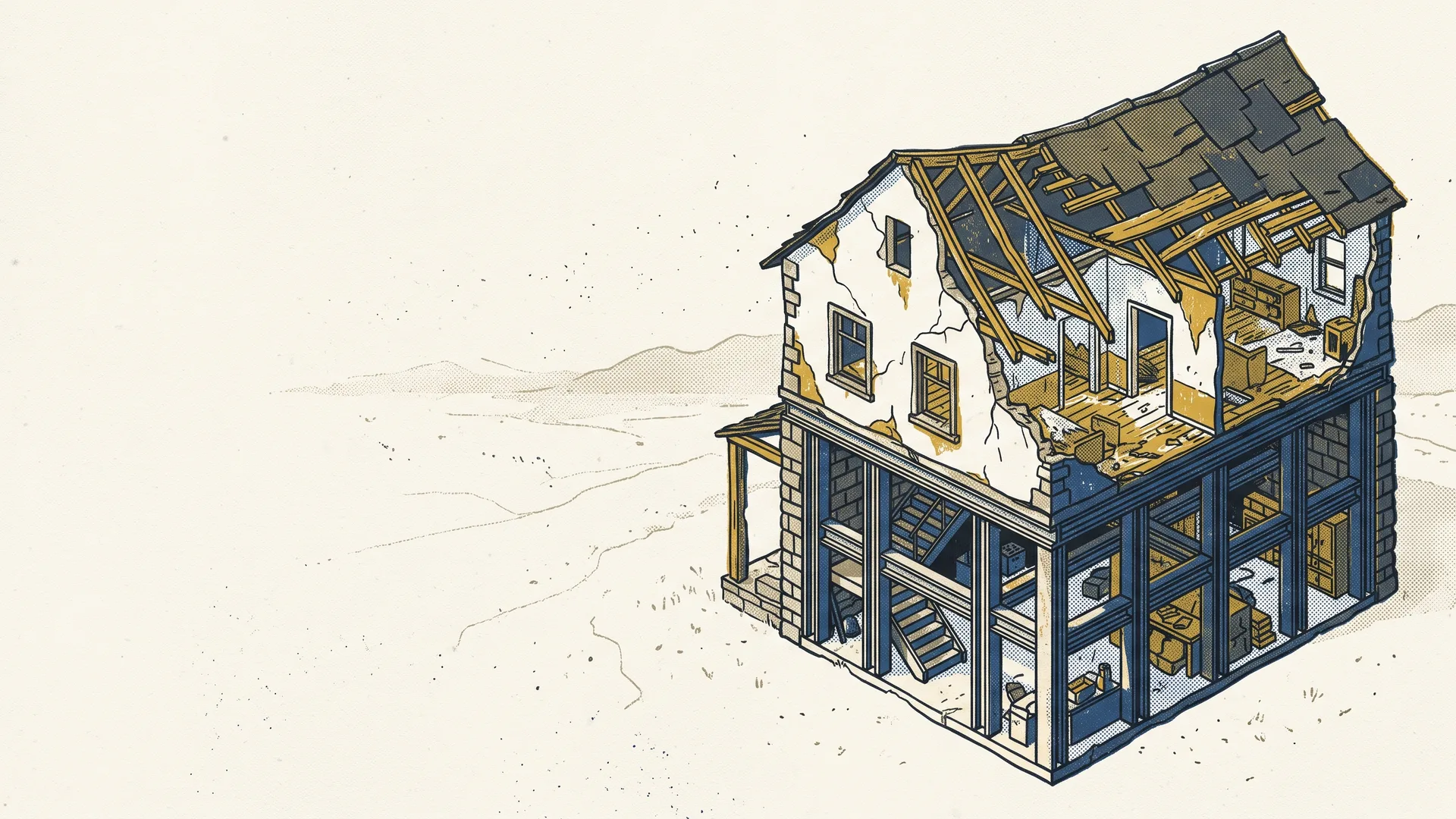
CoreWeave is paying two very different prices for money right now, and both prices are real.
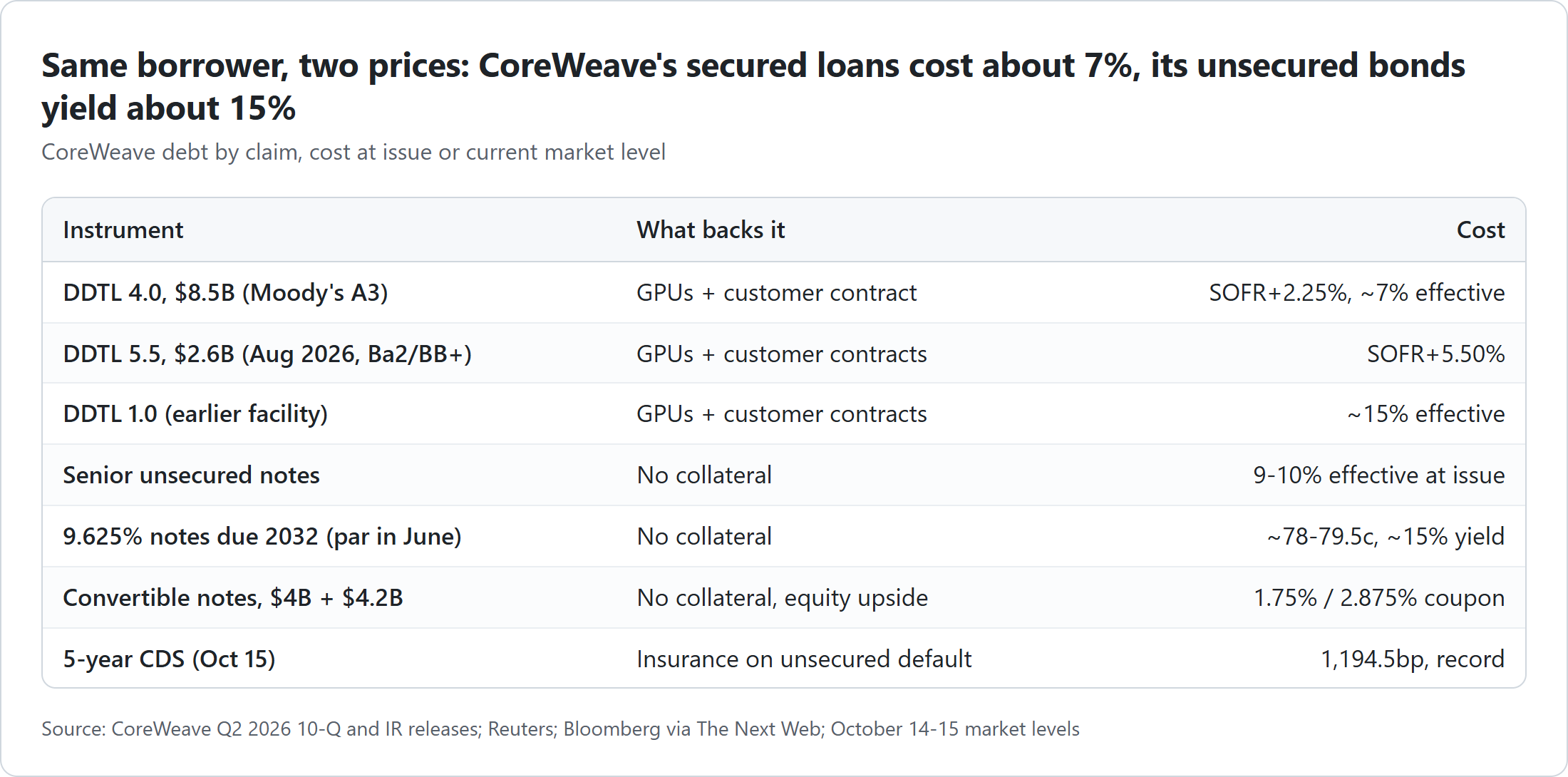
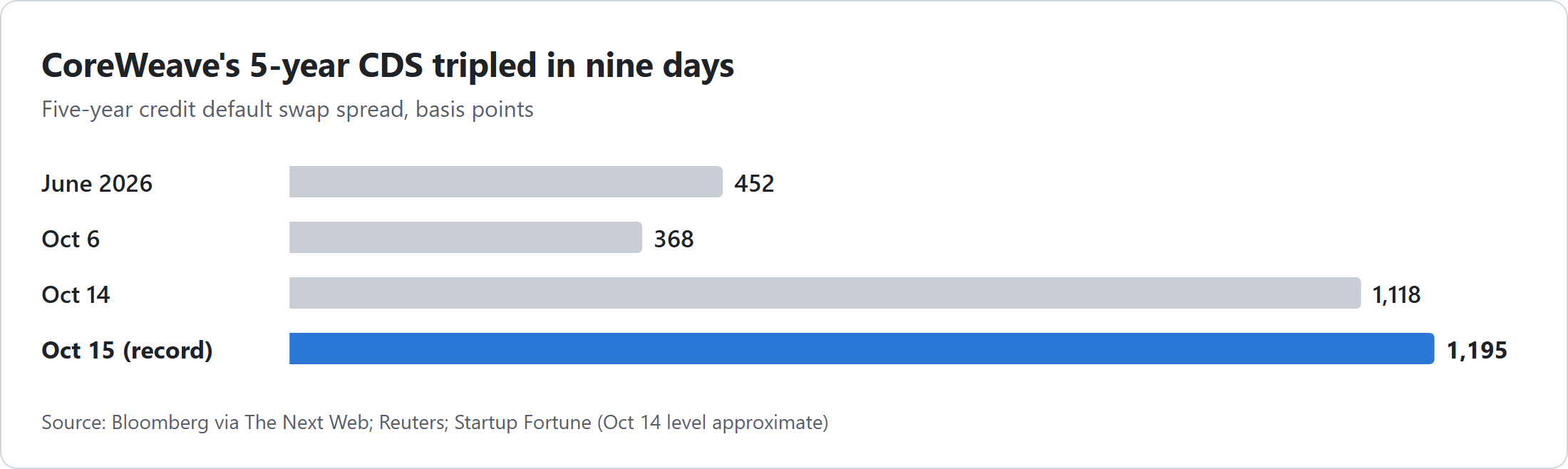
Its $8.5 billion DDTL 4.0 loan, secured by GPUs and the customer contract that pays for them, carries an A3 rating from Moody's and costs SOFR plus 2.25%, about 7% all-in per the 10-Q. Its unsecured 9.625% notes due 2032, sold at par in June, now trade below 80 cents for a yield near 15%. Its five-year credit default swap hit a record 1,194.5 basis points on October 15.
When Jensen Huang says CoreWeave's cost of capital is falling and the bond market prices it near distress, they are describing different layers of the same balance sheet.
Three terms come up a lot below. SOFR is the overnight benchmark rate that floating loans are priced off. DDTL stands for delayed-draw term loan. A basis point is a hundredth of a percentage point.
From CoreWeave's side there is one interest bill. Net interest ran $640 million in the second quarter, roughly 7% a year on $35.55 billion of debt (our arithmetic, net of interest income). That blended number hides the price that matters for a borrower burning cash, which is the price of the next dollar. New unsecured money now costs about 15%, so CoreWeave keeps borrowing against GPUs and customer contracts instead. Each of those deals pledges more assets to the front of the line and leaves the bondholders at the back with less, which is part of why the bonds keep falling. The two prices are also two verdicts. The 7% prices the collateral, and the 15% prices CoreWeave itself. So I sorted CoreWeave's debt by where each lender stands, then did the same for the wider AI build-out. The line has four places in it, and the default pricing sits at the back of it.
CoreWeave's two prices: 7% secured, 15% unsecured
A secured lender has a claim on specific assets. If CoreWeave stops paying, that lender takes the GPUs and the contract cash flow pledged to it. An unsecured lender has a claim on whatever is left once the secured lenders are paid. Same borrower, very different seat.
Here's the basic idea, with made-up round numbers. Say a company owns $100 of GPUs and owes $70 to secured lenders who hold those GPUs as collateral. It also owes $50 to bondholders with no collateral. If the GPUs sell for $80 in a default, the secured lenders get their $70 in full. The bondholders split the remaining $10, or 20 cents on the dollar. The secured loan looks almost safe. The bond looks like a near-total loss. Same company, same default.
The catch for the secured side is the collateral itself. A GPU loses value as newer chips ship, and a loan against it only works if the chip earns its keep for as long as the loan runs. That was the main technical worry on Hacker News's IMF thread, where one commenter asked whether "the debt lasts longer than GPUs remain profitable." Another replied that H100 hourly rental prices have been rising this year. That's one commenter's claim, and I couldn't find a price index to check it.
Lenders handle the depreciation worry by lending against contracts as well as hardware. A pledged contract with a creditworthy customer keeps paying even if the chip's resale value falls.
That's how Huang can say this, in Stockholm, the same week the 2032s fell below 80 cents:
"their cost of capital is actually decreasing"
Jensen Huang, via The Next Web/Bloomberg, October 2026
He's right about the secured tranche. CoreWeave billed DDTL 4.0 as the first investment-grade rated GPU-backed financing, with an A3 from Moody's and an A (low) from DBRS, while CoreWeave itself is rated junk. Secured isn't automatically cheap, though. DDTL 1.0, an older facility, carries about 15% effective, and the newer DDTL 5.5 pays SOFR plus 5.50% with a Ba2 rating. What's pledged, and when the deal was struck, sets the price.
CoreWeave's plan makes the split wider. Co-founder Brannin McBee told the FT the company will pursue investment-grade ratings on more individual facilities, with an investment-grade rating for CoreWeave itself as the end goal. Until then, every facility carved out that way pulls its best collateral and its best contracts into a ring-fenced box. My read is that each box makes the secured layer cheaper and leaves the unsecured holders a thinner residual. So how thin does the market think that residual already is?
What CoreWeave's 1,194bp CDS spread implies (our arithmetic)
A credit default swap is insurance on a bond. The buyer pays a yearly premium, quoted in basis points, and gets paid if the borrower defaults. At 1,194.5bp, protecting $10 million of CoreWeave debt costs about $1.19 million a year.
You can back out a rough default probability from that premium. The shortcut divides the spread by the share a lender loses in default. Assume lenders recover 40 cents on the dollar, the market's standard convention. That gives a hazard rate near 20% a year, or about a 63% chance of default within five years.
At a 20% recovery, the figure is about 53%. This is our arithmetic, a flat-hazard approximation, and published estimates land between 58% and 64%. More than half holds under any recovery assumption I'd defend.
I'm not calling a default here, and I'm not making a trade call either. This is a read of public prices. Single-name CDS overshoots in a selloff, and some of that 1,194 is likely hedging demand. The unsecured layer of CoreWeave is priced the way markets price a borrower that might not make it, while the secured layer is priced the way they price one that will.
The move was fast. The CDS was 452bp in June, when the 2032s were sold, and 368bp on October 6. On October 8 the FT reported that OpenAI told investors its annualized revenue was near $50 billion, below earlier signals, and CoreWeave fell 7.8% that day. By October 14 Chamath Palihapitiya was posting the 15% yield chart and Elon Musk replied with one word: "yikes."
CEO Michael Intrator's memo to staff pushed back:
"market can sometimes misunderstand and act irrationally"
Michael Intrator, via Reuters/The Star, October 15, 2026
Before reading the rest of AI credit the same way, I had to check one bond that looked like it belonged in the same bucket.
Meta's Hyperion bond at 91 cents is mostly a rates story
The Meta Hyperion bond is the obvious comparison, and the easy read lumps it in with CoreWeave. It's a $27.3 billion deal through an SPV called Beignet Investor, priced at par in October 2025 with a 6.581% coupon due 2049. It traded around 91 cents by mid-October. A bond tied to Meta down nine points sounds like credit stress spreading up the stack.
I checked it against Treasuries before believing that. Hyperion yielded as much as 7.55% in late September, per the Motley Fool, when the 10-year Treasury sat around 5.2-5.3%. That gap is roughly 230-240bp, close to the 225bp over Treasuries the bond priced at in October 2025. A 2049 bond loses a lot of price when long rates rise, even if nobody doubts the borrower. Most of Hyperion's drop is duration.
Strictly, a 2049 bond should be measured against the 20- and 30-year curve, so treat that gap as approximate. The rating says the same thing, though. S&P still has it at A+. Pimco anchored about $18 billion of the deal and marked it at 94.5 in late September. That's a paper loss on a rate move, and it says little about Meta. So the build-out debt splits into layers, and each one is priced for a different risk.
The four layers of AI build-out debt
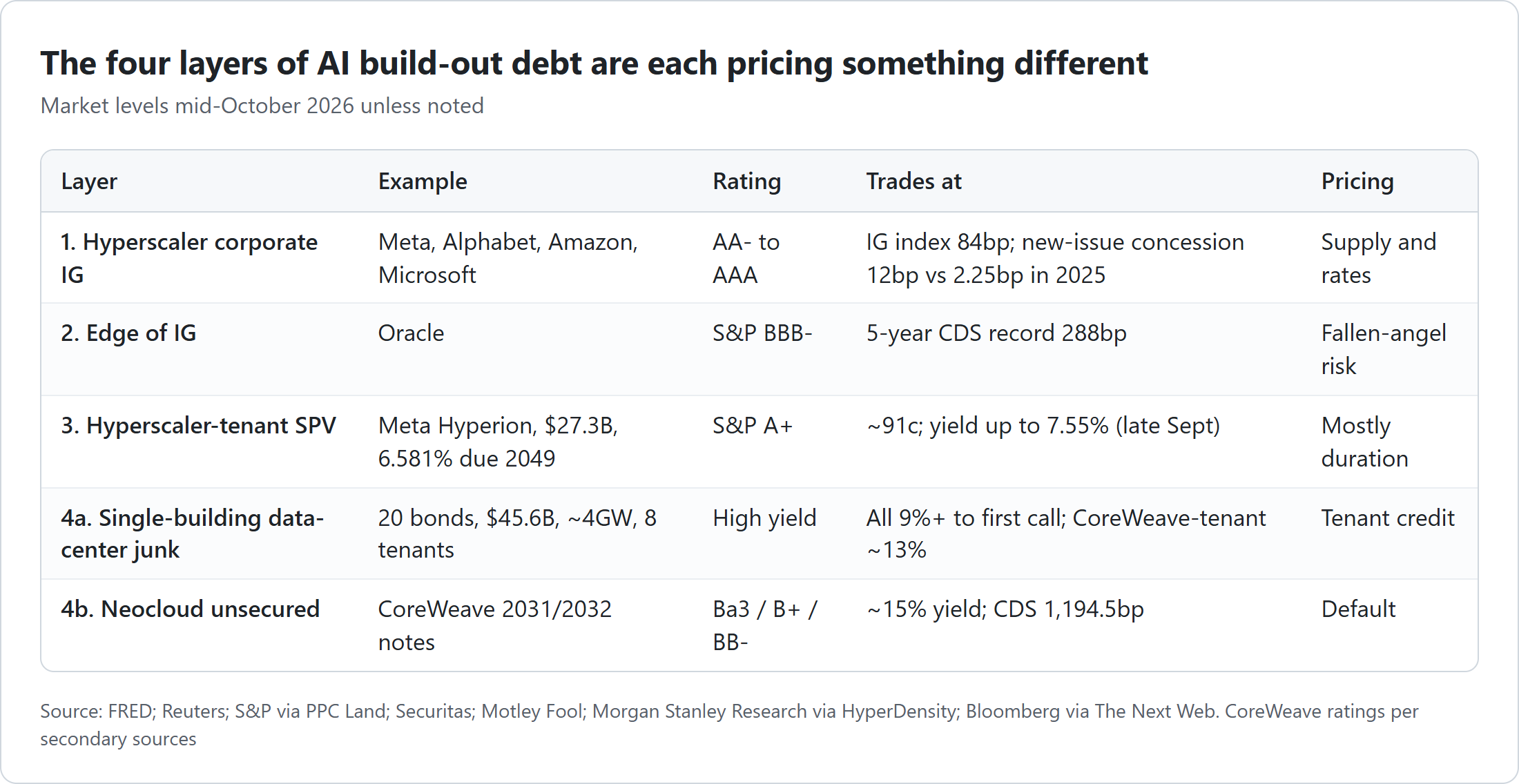
At the top, hyperscaler investment-grade debt is getting pricier for supply reasons. Hyperscalers now account for 10% of global IG issuance, up from under 1% in 2024, per the IMF. Median new-issue concessions rose to 12bp this year from 2.25bp in 2025, per Reuters. The IG index spread was 84bp on October 15. Buyers want a discount to absorb the volume. Default risk at Meta or Microsoft has barely moved.
Oracle sits at the edge. S&P cut it to BBB- on July 9, one notch above junk, and its five-year CDS reached a record 288bp. That's a price for fallen-angel risk, the chance an IG name drops into high yield and forces holders who can't own junk to sell.
The bottom layer is the one priced for default, and it comes in two forms. One is the unsecured debt of neoclouds, the GPU cloud providers that aren't hyperscalers, such as CoreWeave. The other is debt on single buildings.
Single-building junk: $14.1B of it is leased to CoreWeave
Data centers get financed one building at a time. A project company owns the building, a tenant signs a long lease, and the project company sells bonds backed by that lease. Morgan Stanley Research, using Bloomberg data as of September 28, counts 20 of these bonds in high yield: $45.6 billion financing about 4GW across eight tenants. I haven't seen the note itself. The numbers come through HyperDensity and ZeroHedge, and both report the same figures:
"As of late September every one of the twenty yielded at least 9% to its first call date, including buildings leased to Amazon and Nvidia… the seven CoreWeave-tenant bonds averaged about 13%."
Cooper Westendarp, HyperDensity, summarizing Morgan Stanley Research and Bloomberg data as of September 28
CoreWeave is the tenant on seven of the 20, covering $14.1 billion, or 31% of that market. A recent example is DDC 01 Propco, a Blue Owl-backed site. It sold $1.1 billion of five-year notes at 9.25% in September, about 270bp over similarly rated debt, against a 15-year, $2.94 billion CoreWeave lease on 76MW, per Bloomberg.
Picture this from the bondholder's side. You own one building and one tenant. The lease looks like a 15-year annuity. The tenant's own unsecured bonds trade at 78 cents. Your claim is structurally separate from those bonds, but it rests on the same company paying rent. The IMF uses a term for this pattern among AI investors in its October report, and it fits here too:
"distress at key investee firms could present significant 'wrong-way risk'"
IMF Global Financial Stability Report, October 2026
Wrong-way risk means your exposure grows exactly as your counterparty weakens. A lease is worth the most on paper right when the tenant is least able to pay it. ZeroHedge asked it straight: "Is that Junk Squared?"
The funding gap behind CoreWeave's 15% bonds
The unsecured price comes down to timing. CoreWeave produced $3.66 billion of operating cash flow in the first half of 2026 and spent $14.12 billion on capex. Deutsche Bank models about $10 billion of operating cash flow over the next 12 months against about $45 billion of capex. That $35 billion gap gets funded with new debt or equity.
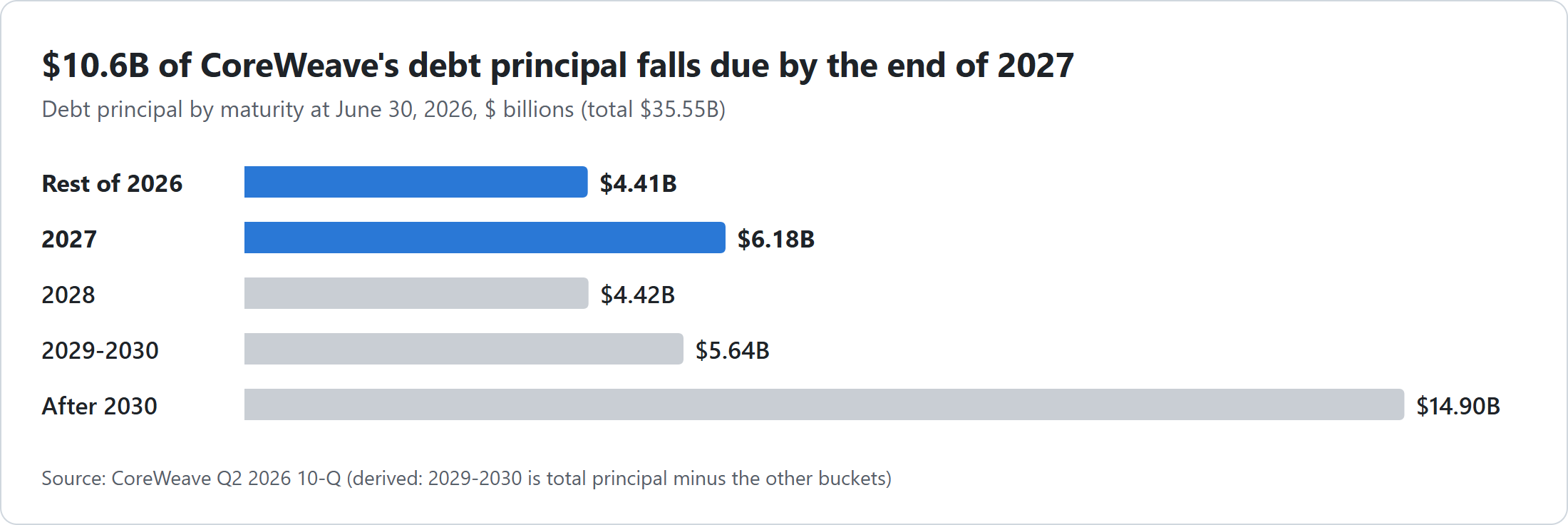
Net interest expense was $640 million in Q2, 24.9% of $2.58 billion in revenue, per the 10-Q. Debt principal rose to $35.55 billion from $21.62 billion at the end of 2025, with another $16.32 billion of operating leases on top. And $10.6 billion of principal falls due by the end of 2027. Every dollar of that rolls into a market where CoreWeave's unsecured cost went from 9.625% to about 15% in four months.
Rates are moving the wrong way for a borrower that has to refinance. The Fed hiked to 3.75-4.00% in September. Futures put about 94% odds on a December hike, and Citi now forecasts one. The secured facilities float off SOFR, so they reprice the moment the Fed moves. The fixed unsecured debt reprices at each refinancing. A December hike reaches CoreWeave through both doors.
The spread data points at the borrowers. Goldman's high-yield AI basket hit 360bp after widening 25bp in one day, October 13-14, while non-AI high yield moved 2bp. That comes secondhand, via CoinCentral's summary of Goldman's strategists. Goldman's Amanda Lynam reads it as a reassessment of AI build-out economics for lower-rated borrowers, with rates as the added pressure.
The bull case, and where it actually disagrees
The bull case is real, and it starts with the backlog. CoreWeave reports $104.2 billion of it. Deutsche Bank's Brad Zelnick stays constructive:
"the vast majority of CoreWeave's backlog is associated with long-term take or pay contracts where contracted revenue fully covers all capital and operating costs associated with the contract and generates a return for the company"
Brad Zelnick, Deutsche Bank, via Investing.com, October 2026
He notes 60-65% of that backlog sits with investment-grade customers and that CoreWeave has $15.5 billion of available liquidity. The customer list is short, though. One customer was 36% of Q2 revenue and another 26%, per the 10-Q. Nvidia also holds a $6.3 billion capacity-purchase agreement through April 2032. That's a demand backstop. Nvidia hasn't guaranteed any of the debt.
Bull and bear both accept the backlog. They split on sequencing. A take-or-pay contract starts paying once the capacity is delivered. Capex and interest get paid before that. Delays on the delivery side, like power, construction and gas pipelines, stretch exactly the gap the unsecured holders are pricing. They've already hit Oracle-linked projects: the $18 billion Project Jupiter loan trades below 90 cents after a force-majeure notice tied to a delayed pipeline.
Ben Horowitz told the dot-com version of this story about LoudCloud. Bandwidth went from $1,500 a megabit to $50:
"if you borrowed money to get it, you're dead"
Ben Horowitz, via @a16z, October 2026
To be fair, Horowitz argues CoreWeave faces the opposite problem today, a GPU shortage, and calls that a tailwind for the company.
The current-cycle input to watch is price. BofA's Sebastian Raedler notes that average token prices have fallen around 50% since the summer. Take-or-pay protects the contracts already signed. The next contract gets priced at whatever tokens are worth by then. I wrote about the other side of these contracts in Anthropic's $413.7B take-or-pay bill. Commitments like those are the backlog that neoclouds pledge to their lenders.
What each layer of AI debt is pricing
Line the layers up and each one is answering a different question. Hyperscaler IG is pricing supply and rates. Oracle is pricing the chance it falls out of investment grade. Hyperion is pricing duration. The single-building bonds and CoreWeave's unsecured notes are pricing whether the wait for AI revenue outlasts the borrower.
Huang and the bond market can both be right because they stand in different places in the line. For now the risk sits at the back. It moves forward if collateral quality slips. If GPU values fall faster than the loans pay down, or a pledged customer contract gets cut, the secured lenders take losses too. The newer secured money is already pricier. DDTL 5.5 costs SOFR plus 5.50% with a Ba2 rating, against SOFR plus 2.25% and an A3 for DDTL 4.0, which suggests the best collateral was pledged first. That spread is the one to watch.
The funding gap also tells you what CoreWeave does next. It keeps funding through the cheapest door left open: more secured facilities, more convertibles, and a 35 million share at-the-market program that sells stock into the market as needed. Each of those is cheaper than a new 15% bond. The secured facilities push the existing unsecured holders further back in line. The convertibles and new stock mostly dilute shareholders, and the converts rank alongside the existing bonds.
Two near-term events will test it. CoreWeave reports Q3 in November, which refreshes every balance-sheet number here. The Fed meets October 27-28 with a hike about one-in-three priced, and again in December with a hike mostly priced. If the backlog converts to delivered capacity faster than the debt comes due, the unsecured layer reprices back up. If it doesn't, the back of the line is where the losses land, and the front of the line keeps getting paid.