Anthropic's Draft S-1: The $42B Loss That Isn't, and the $413B Bill That Is
Anthropic is getting ready to go public, and its draft filing shows a $42 billion loss for 2025. That sounds like a company burning through cash.
But most of it isn't cash. It's an accounting charge that grew because Anthropic became more valuable. The number that actually binds the company is $413.7 billion: the computing power it has promised to pay for over roughly the next decade, whether or not it uses it. That bill, not the loss, is what Anthropic has to grow into.
Both figures come from the confidential draft S-1 that Reuters reviewed and reported on September 28-29. Nothing is public on EDGAR, the SEC's filing database, yet. Anthropic confidentially submitted the draft on June 1, and the public S-1 has to appear on EDGAR by late October if marketing starts the week of November 9, which points to around October 25. Every 2025 figure below is the draft as Reuters and the outlets that followed it reported it, and the public version can still move any of them.
Per that draft, Anthropic's 2025 operating loss was $8.06 billion on $4.59 billion of revenue. About $34 billion of the ~$42 billion net loss is a non-cash charge on financing that can convert into shares. The fixed cost sits in the compute contracts: $413.7 billion of $518 billion in commitments is take-or-pay, and $221 billion of the locked portion is owed to Amazon and Google, the same two companies that sold 47% of Anthropic's 2025 revenue and own its equity.
I came up through credit underwriting, and 13 years in financial services trains one reflex into you. Sort every loss twice. Is it cash? Can it be cancelled? Run the draft prospectus through those two questions and the $42 billion headline drops to a footnote while the compute contracts move to the top of the file.
The two-question sort: cash or non-cash, fixed or variable
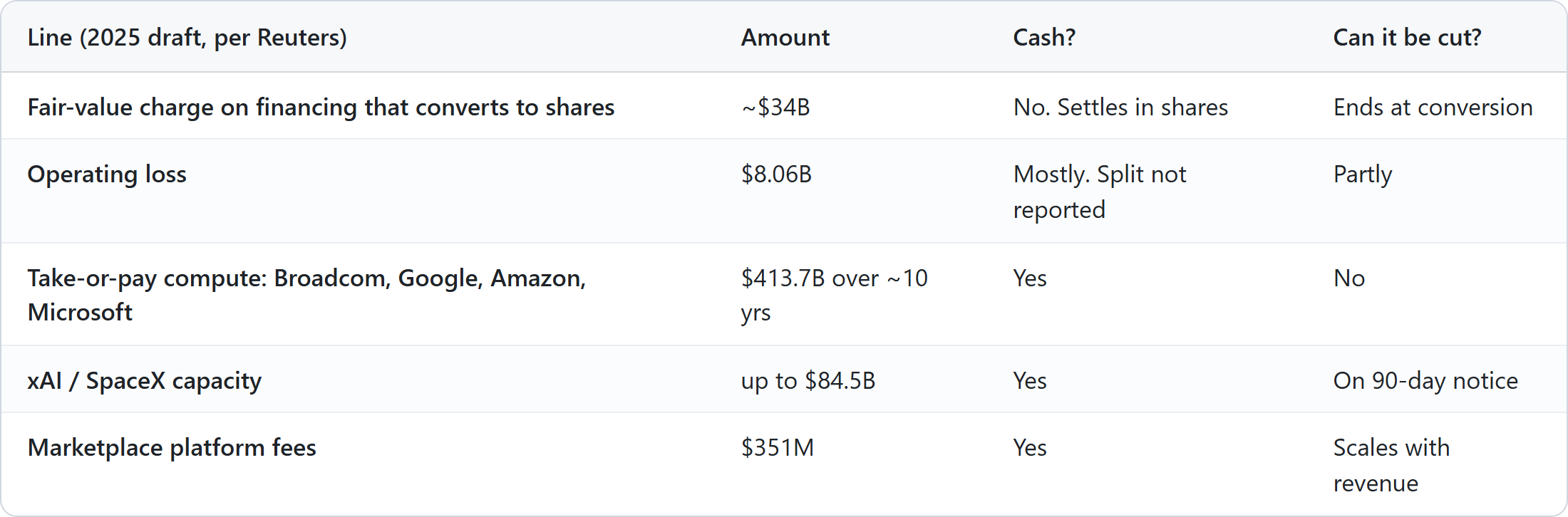
The headline lives in row one, and no cash leaves the building for it. Row three is cash that can't be cancelled, and it runs for a decade.
Two terms carry the argument, so here they are in plain English. A take-or-pay contract obliges the buyer to pay for a minimum volume whether it uses that volume or not. A fair-value liability is a debt-like instrument the company re-prices every reporting period, with any change running through profit and loss.
Why Anthropic's $42B net loss is mostly a non-cash mark
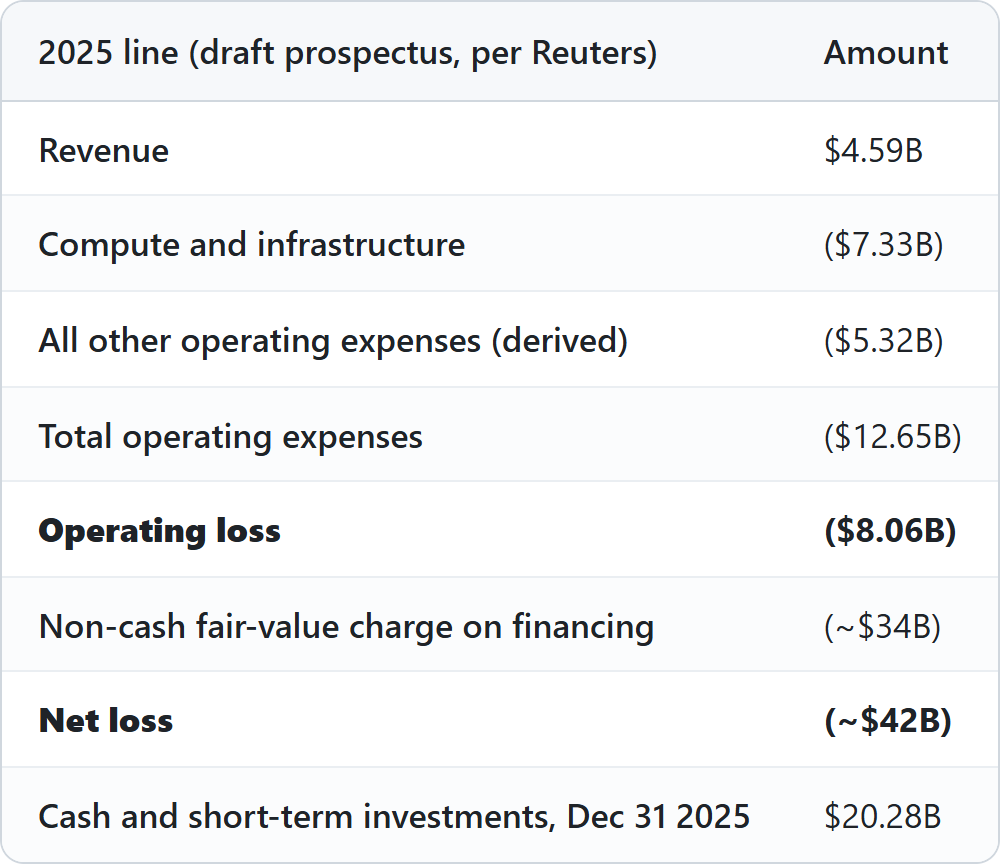
Compute and infrastructure cost $7.33 billion, three times the 2024 figure and 1.6x revenue. Total operating expenses came to $12.65 billion, which leaves the $8.06 billion operating loss on $4.59 billion of revenue. That loss nearly tripled from $2.98 billion in 2024, so the cash-side loss is real and growing. The $34 billion below the operating line is the part that doesn't belong in a cash-burn headline.
Reuters describes the charge this way:
"a roughly $34 billion accounting charge that reflected an increase in the estimated value of financing that could eventually turn into Anthropic shares, rather than money the company spent running its business"
Reuters, reviewing the draft prospectus, September 28, 2026
KuCoin's summary calls it an "increased estimated fair value of financing liabilities." The arithmetic reconciles. $42 billion minus $8.06 billion is about $34 billion.
Here's the basic idea, with made-up round numbers. Say an investor holds a note that converts into 1% of the company. At a $200 billion valuation, that note is worth about $2 billion, and the company carries it as a $2 billion liability. If the valuation doubles to $400 billion, the same note is worth $4 billion. The liability rose $2 billion, and that $2 billion lands in the income statement as a loss. No cash moved.
The reporting doesn't name the instrument. Convertible notes are the likely candidate. Amazon put $8 billion into Anthropic convertible notes through 2025, and its 10-K put their fair value at about $45.8 billion at the end of 2025. Amazon booked the same kind of gain from the holder's side. It's plausible those notes are the instrument behind Anthropic's charge, but nobody has confirmed it.
Don't get me wrong, non-cash still costs somebody. The bill arrives as dilution. When those instruments convert, existing holders own a smaller slice of the company. And if the IPO prices above $2 trillion, the mark can grow again before conversion, so 2026 could print another large non-cash loss for the same reason. Once the instruments convert, the line goes away.
The viral read skipped the split. The most-shared version on X:
"lost $42 billion in 2025, with just $4.6 billion in revenue"
@BenjaminNorton, 2.3K likes
Simon Willison made the timing point on Hacker News: the reported numbers are "entirely for 2025," while 2026 growth has been "enormous." The sharpest rebuttal I found had six likes:
"If you want something to worry about, it's the $518B... Not a $42B number you got from a headline"
That's where the file gets heavy.
$413.7B of Anthropic's $518B compute bill is take-or-pay
The draft lists at least $518 billion of compute commitments with six partners over roughly a decade. About 80% of it is "non-cancellable or requires payment regardless of usage." The contract language is blunt:
"If our actual spend falls short, we must pay Google the difference."
Draft prospectus, via Reuters
Similar terms apply to Amazon. Here's the stack by counterparty:
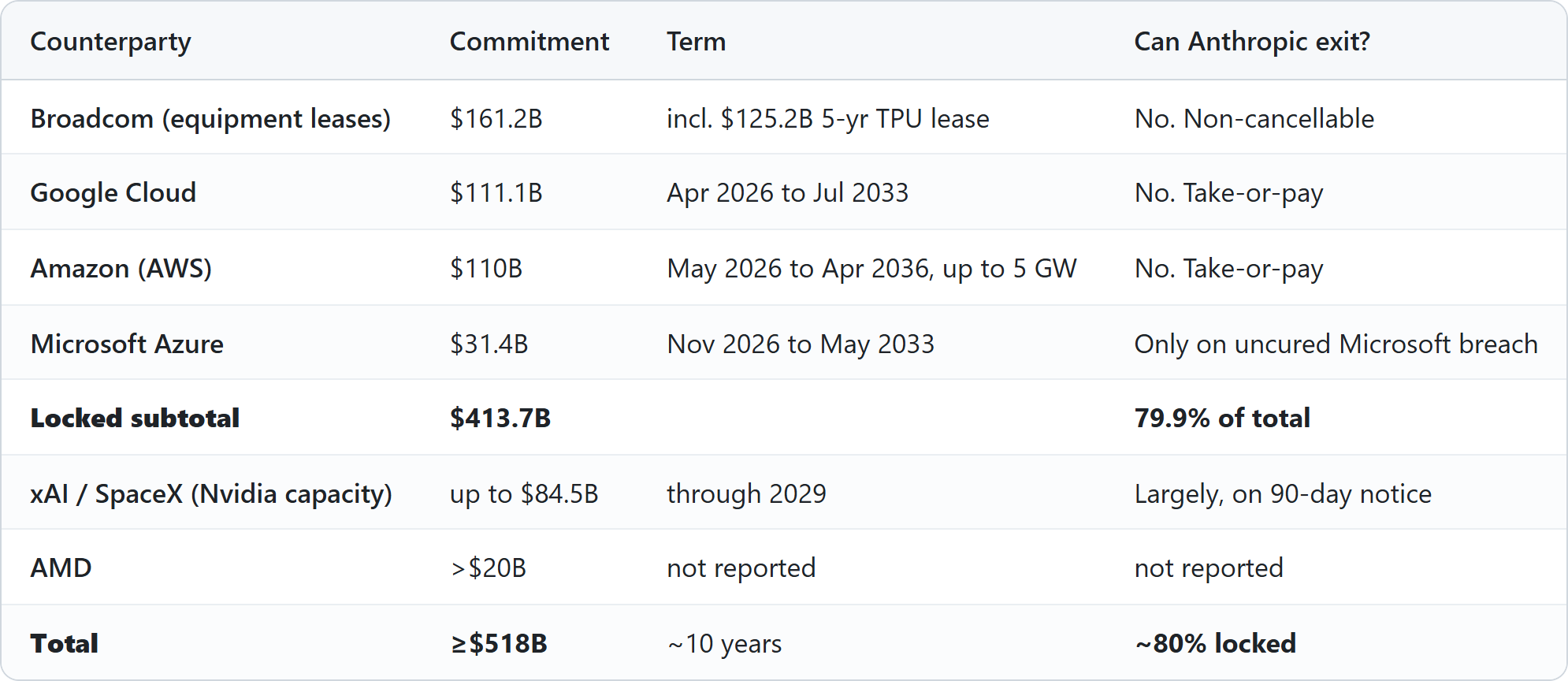
The flexible fifth is mostly the xAI and SpaceX capacity, "largely cancelable with 90-day notice." So the part Anthropic can walk away from is the newest, shortest-dated and least strategic piece of the stack. The contracts that run to 2033 and 2036 are the ones that can't be cut.
Broadcom adds a second layer. It will lend Anthropic up to $42 billion in convertible notes, about a third of the $125.2 billion five-year TPU lease. Certain defaults could make a "substantial portion of lease obligations immediately due" and cut off the loan at the same moment. The draft itself flags "potential conflicts of interest." Broadcom is the supplier, the lessor and the lender, and its loan converts into the borrower's equity.
What the take-or-pay stack costs per year (our math)
The draft as reported has no year-by-year obligations table, so any annual figure is derived. The number circulating on X is $41 billion a year. That's $413.7 billion divided by ten. It was the first version of this math I ran, and it's too flat. The contracts are shorter than ten years, so a straight line pushes cost into years when most contracts have ended and understates the years when they all overlap.
Splitting it by contract gives a steeper profile:
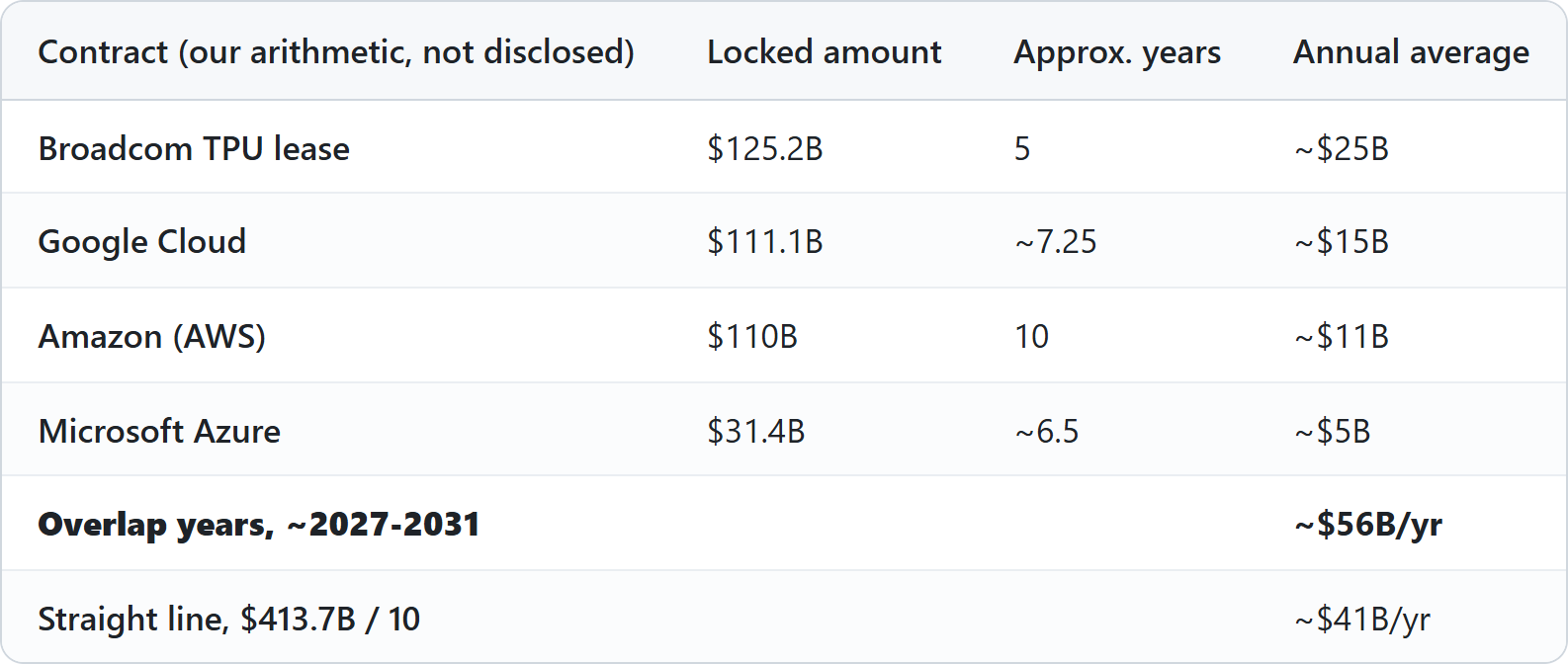
The other ~$36 billion of Broadcom leases isn't broken out by term, so it's left out, which if anything understates the overlap years. The disclosed schedule, when it arrives, could also be front-loaded or ramped with capacity delivery. All of it is arithmetic on reported totals and terms.
Set against revenue, the range looks like this. Q2 2026 revenue passed $11.5 billion, per investor materials reported by TNW, which come from outside the draft. Annualized, that's about $46 billion. The straight line is 0.9x that run-rate. The per-contract profile is 1.2x.
Our arithmetic again on funding. Add the $20.28 billion of year-end 2025 cash and short-term investments, the $30 billion Series G in February, the $65 billion Series H in May, and an IPO raise of $60 billion to $100 billion. The total comes to roughly $175 billion to $215 billion. At $41 billion a year it covers the locked stack for four to five years before any operating cash flow. At $56 billion, three to four. It ignores 2026 cash already spent and anything prepaid, so treat it as a ceiling.
Fixed costs against revenue that can leave
PitchBook put the structure in one line:
"Revenue can fall within a quarter, while minimum infrastructure payments remain committed for years."
PitchBook, via Morningstar, October 2, 2026
That's operating leverage. With a fixed base of $41 billion to $56 billion a year, every revenue dollar above the line falls mostly to operating income, and every dollar of shortfall comes straight out of it. Q2 2026 was the first quarter of positive adjusted operating income, per investor materials the FT reported. So far the leverage is running in Anthropic's favor.
The revenue side is concentrated. Two unnamed customers were about 24% of 2025 revenue, 12% each, and per Reuters' reading of the risk factors they are "not bound by long-term contracts and could reduce or halt spending." About 83% of 2025 revenue was metered usage, $3.8 billion of API and marketplace against $789 million of subscriptions. The Information reported on October 5 that Meta's internal Claude users fell from 60,000 to 30,000 after caps and that Microsoft cut its Claude spending by more than a third. Whether either is a top-two customer isn't known.
Amazon and Google are channel, supplier and shareholder at once
The filing identifies Amazon, Google and Microsoft as investors, customers, cloud providers, distributors and competitors, per IBTimes' summary. For Amazon and Google, that list maps onto separate lines of Anthropic's economics:
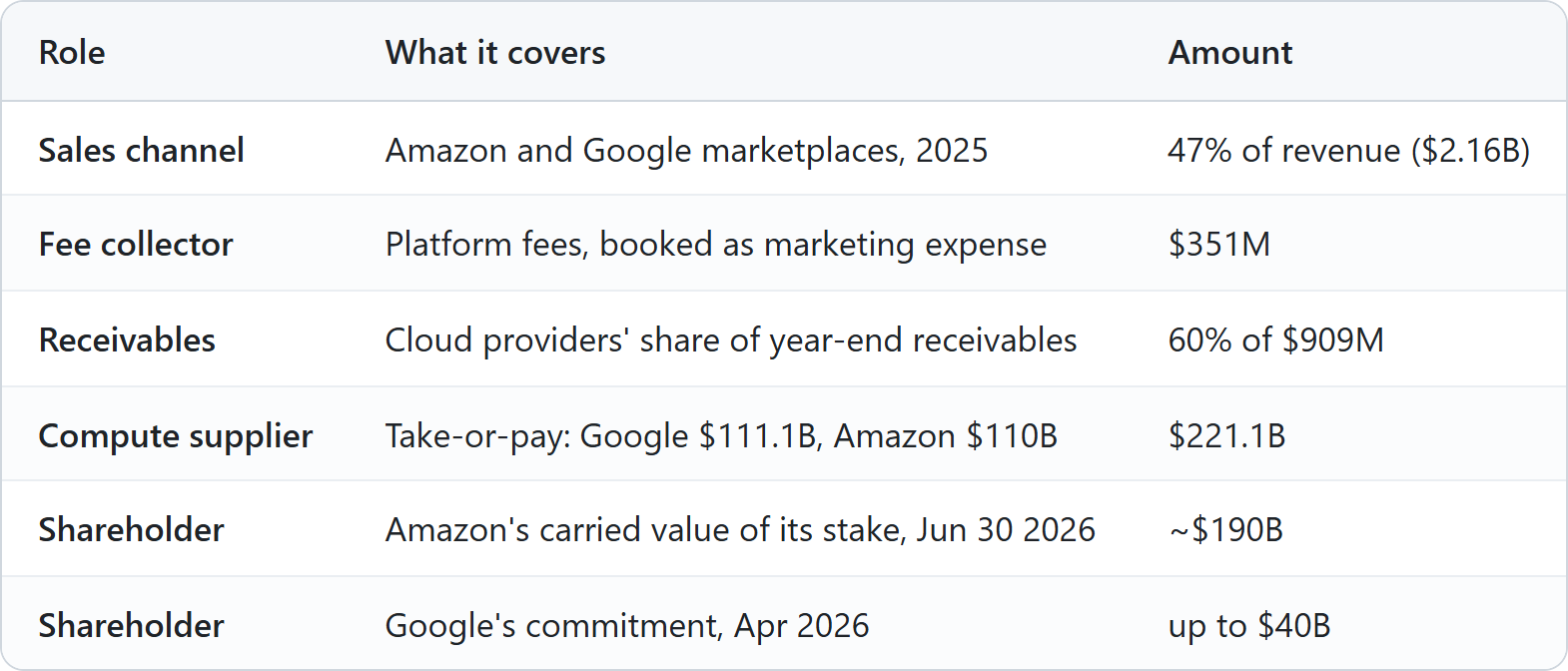
The channel share climbed fast. 47% of 2025 revenue came through the two marketplaces, up from 32% in 2024 and 11% in 2023.
Anthropic books those marketplace sales gross. The full contract value counts as revenue, and the $351 million of platform fees sits in marketing expense. The fees work out to about 16 cents per marketplace dollar. Netting the fees would take 2025 revenue from $4.59 billion to roughly $4.24 billion (our arithmetic). Small in 2025. Bigger as the channel grows.
Gross versus net is also why an OpenAI comparison rattled markets on October 8. The FT reported that OpenAI told investors its annualized revenue was near $50 billion, against the ~$70 billion some investors had derived by restating OpenAI on Anthropic's gross method, per a summary of the FT report. Same industry, two revenue definitions, a $20 billion gap.
Follow one dollar through the loop. A customer buys Claude through AWS Marketplace. Amazon keeps a fee, which Anthropic books as marketing. Anthropic then pays Amazon a take-or-pay minimum for compute. Amazon marks up its Anthropic stake as the valuation rises. And the same take-or-pay contract presumably sits in AWS's backlog as contracted revenue, the kind of backlog that carried the hyperscaler capex story in Q1. One contract, recorded as a fixed obligation on one side and as booked demand on the other.
The same summary says Anthropic warns those relationships can create incentives that are not fully aligned with its own. In a stall, they'd line up fast. Amazon and Google would lose channel revenue, hold receivables from a strained customer and watch their equity marks fall, while the take-or-pay minimums kept coming due to them. Their cheapest move would be more capital or softer terms. Enforcing a default clause against a company they own, sell and supply would hit them three times.
Firmus shows which side of take-or-pay public money will fund
Every take-or-pay contract has a seller on the other side, and for a neocloud that contracted backlog is the IPO pitch. October priced the two sides very differently.
Firmus, the Nvidia-backed Australian neocloud, asked for an A$43.7 billion valuation, about US$30.4 billion, on a A$7 billion raise. It had 42-46MW built against a pipeline of roughly 865MW to 912MW (the reports differ), so about 5% built. It cut the price on October 7, by about 18% or about 25% depending on which report you read, and pulled the deal on October 8 UTC.
"Only ~46MW operational against 900MW+ contracted"
Matthew Sigel, VanEck
Local fund managers were blunter. "When it comes to the crunch, the demand seems like it isn't there," Jun Bei Liu of Ten Cap said, per ZeroHedge's roundup. Romano Sala Tenna of Katana was shorter: "We are struggling with the fundamental arithmetic."
Firmus had company. SoftBank's SB Energy delayed its ~$50 billion IPO the same fortnight, with first-half revenue of $138.7 million against a $3.21 billion net loss and no data center online. Lambda chose to stay private, raising up to $4 billion after its backlog grew from $15 billion in June to $50 billion in September.
The window is still open for compute companies with a product. Cerebras priced in May at $185 after raising its range, took in $5.5 billion and closed day one at $311.07, up 68%. Cerebras had a product in customers' hands and revenue to show. Firmus had contracts for capacity that mostly didn't exist yet.
So public money is lining up behind the buyer of take-or-pay compute, the company with $11.5 billion of quarterly revenue and more than $20 billion of cash. The seller asking investors to fund the 95% that isn't built got sent home. The market put the execution risk where the concrete hasn't been poured.
What the public S-1 has to show in late October
Six things would change this read when the public filing lands:
- The obligations-by-year table. It settles whether the locked stack runs closer to $41 billion a year or $56 billion.
- The cash flow statement. Operating cash flow is the numerator for fixed-charge coverage. Gavin Baker has said Anthropic is generating cash, and no reported figure confirms or refutes it yet.
- The instrument behind the $34 billion, and how much the mark grows at a $2 trillion price before conversion.
- Q3 2026. A second positive adjusted operating quarter would matter more than any 2025 line.
- Whether the total moves above $518 billion as capacity deals signed after the draft get counted.
- Customer concentration in 2026, and whether the Meta and Microsoft cuts landed on a top-two customer.
The valuation range is already wide. New Constructs put fair value around $150 billion and called it the "most absurd IPO of 2026." A liquid pre-IPO market was implying $2.089 trillion on October 5. That's a 14x spread, and both ends are arguing about the same fixed stack. One prices it as a liability. The other prices it as capacity the revenue curve will fill.
Anthropic is asking public investors to buy a company whose costs are signed through 2036 and whose revenue is earned one quarter at a time. Q2 showed the revenue can outrun the bill. The public S-1 is where we find out whether it does that in cash.
Analysis of figures reported from a draft filing. Not investment advice. Nothing on this page should be acted on as financial guidance.