The Financial Plan Advisors Charge Thousands For, Free and Open Source
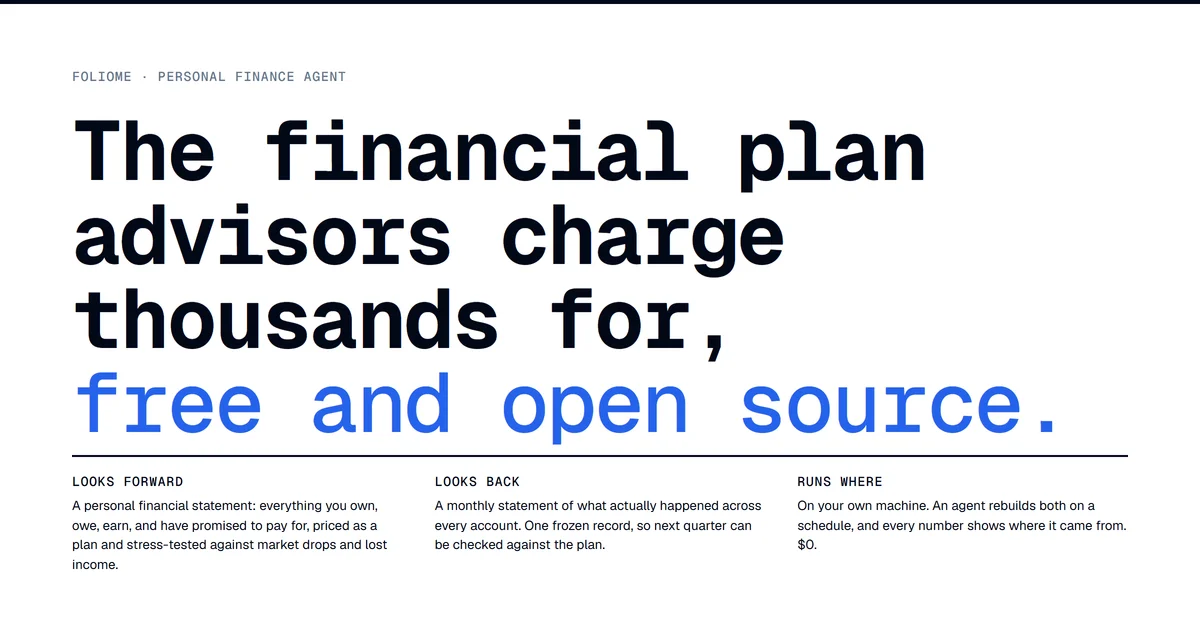
I just pushed two things to Foliome that matter to anyone managing their own wealth: the Personal Financial Statement and Periodic Statements.
They're two halves of one idea. Most financial institutions give you one of them at no extra cost, at best. Foliome is open source and gives you both for free.
The Personal Financial Statement looks forward: everything the household owns, owes, earns, and has promised to pay for, turned into a plan with dates, prices, and what-ifs. This is what I have always wanted to build ever since earning the CFA charter in 2019.
The Periodic Statement looks back: what actually happened across every account over a month or a quarter. A business runs on both, a budget and a set of books, and checks one against the other.
Most households have neither. They have an app that shows balances, and the rest lives in their heads: watching for certain numbers, hoping to remember what to do when they show up, and trusting the app read the numbers right in the first place.
What a personal financial statement actually is
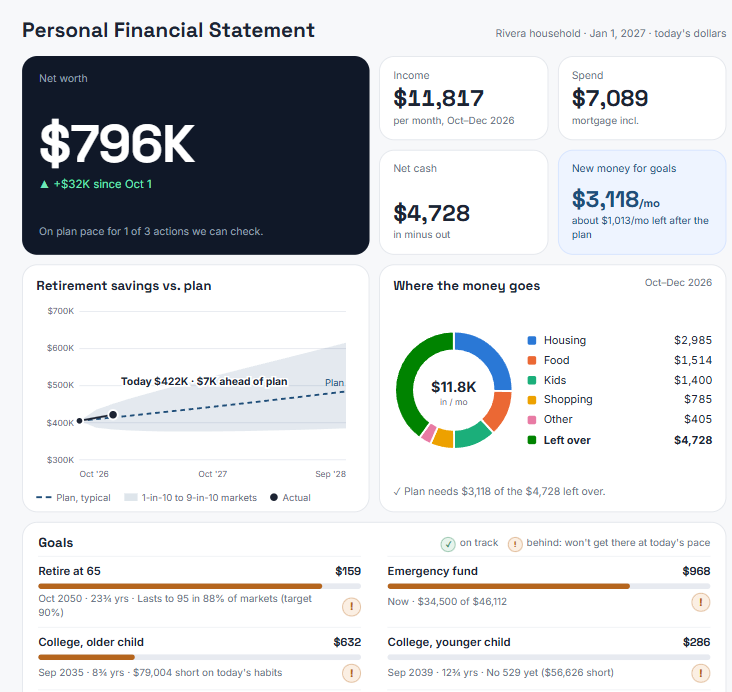
The PFS is not a dashboard. Let me explain.
The PFS sits at the center of wealth planning. It's where everything meets: account balances, paychecks, taxes, the mortgage, college in 9 years, retirement in 24. Each piece comes from a different place and rests on its own assumption. The PFS weighs what the household will earn against what it has promised to spend, and puts a price on each goal. Then it tests the plan: retire at 60, markets fall 30%, one income stops, etc. You end up with one document you can sit down with and decide from.
The fundamentals are the same for every household, and it's beautiful when put together. But it is a nightmare from a data monitoring perspective.
In practice it lives across spreadsheets and documents with too many tabs, built once, never updated, and breaks when adding or taking away an assumption.
That's the part agents change.
An agent can move across data in very different shapes and carry as many assumptions as the plan needs, each with its source attached. A document that plans the next 30 years of a household's life can now be built for free, on your own machine, and rebuilt whenever something changes.
A dashboard reads your data. A PFS is a plan.
Dashboards are everywhere now. Your bank has one. Your brokerage has one. Foliome has one too, and I use it every day.
A dashboard assumes your problems are simple. Balance up, spending down, bill due Thursday. For most households the questions are harder. Can we pay for college and still retire? What if one of us stops working? What happens to all of it if the market drops? With this market, answering these questions is crucial.
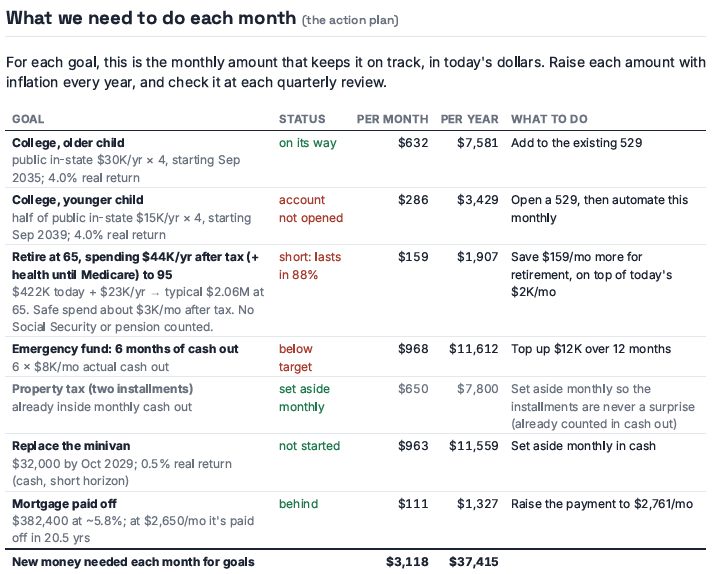
Ask your dashboard how it handles a market shock. It can't. It doesn't know what a market shock is, let alone what one does to you. It shows you what happened, after it happened.
A PFS runs it ahead of time. Your PFS should have a what-if page. Each line re-runs their whole lifetime balance sheet with one thing changed:
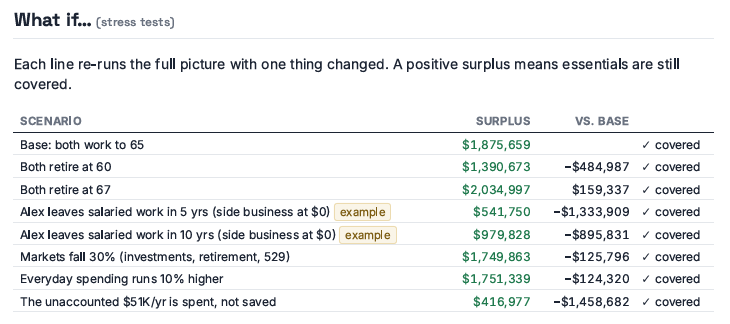
That's three things a dashboard can't give you. It answers forward questions: if we change nothing, do the goals get funded, and what do we do each month? And this is set up so that at next review time, it can be checked against the pace the plan asked for. And it has to tie out, so money nobody can explain becomes a line item instead of disappearing.
Wealth management shops have teams, but agents can run this. Foliome can rebuild the statement on a schedule, from fresh data and custom assumptions, and every number shows where it came from. Each period you can see what changed, what needs doing, and what happens if you don't do it.
What makes a good PFS
The curriculum doesn't prescribe one format. It gives you the pieces. I built around four of them:
- The family extended balance sheet. The usual assets and debts, plus the ones you can't see on a statement: the present value of future paychecks on one side, and of everything you've committed to spend (lifestyle, college, the mortgage) on the other.
- The goal matrix. Each goal gets a date, a cost, and a tier: essential, important, or want. Essential goals need higher odds of success.
- The multi-year cash flow. Spending in phases. Childcare ends. The mortgage gets paid off. Retirement adds health insurance until Medicare.
- The liquidity table. What you can reach in a bad month, and what's locked up in a house.
Then each piece has to clear three bars. It has to be trusted: every number shows where it came from, and the totals tie out. It has to be understood: answer first, plain words, rounded summaries. And it has to be useful: every goal tied to a monthly action, with today's path shown next to the plan.
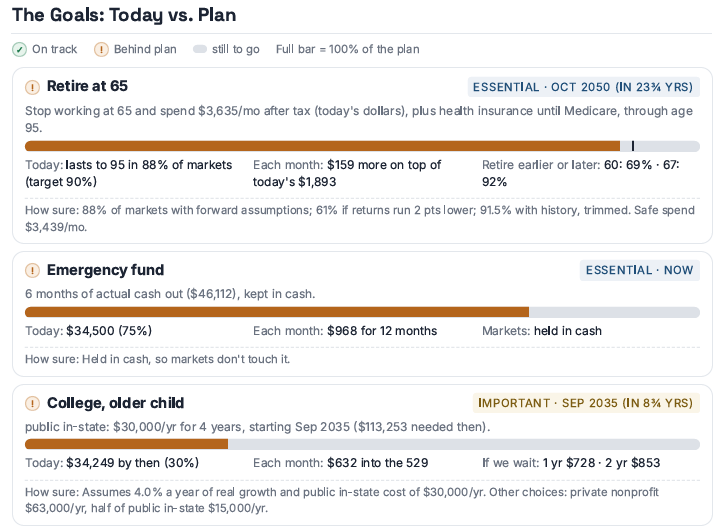
Goals-based investing: every dollar gets a job
The goal matrix is a format. Goals-based investing is the principle behind it.
Most portfolio advice treats your money as one pile with one risk tolerance. Goals-based investing splits it by purpose. Each goal gets its own horizon, its own price, and money held to match. Retirement 24 years out can ride the market. The emergency fund can't. College in 9 years sits somewhere in between.
The curriculum offers two ways to carve it up. Jean Brunel's goals-based subportfolios give each goal its own slice of money, invested for that goal alone. Ashvin Chhabra's three buckets sort money by what it protects: safety guards against ruin, market keeps your lifestyle on track, and aspirational is upside you can afford to lose.
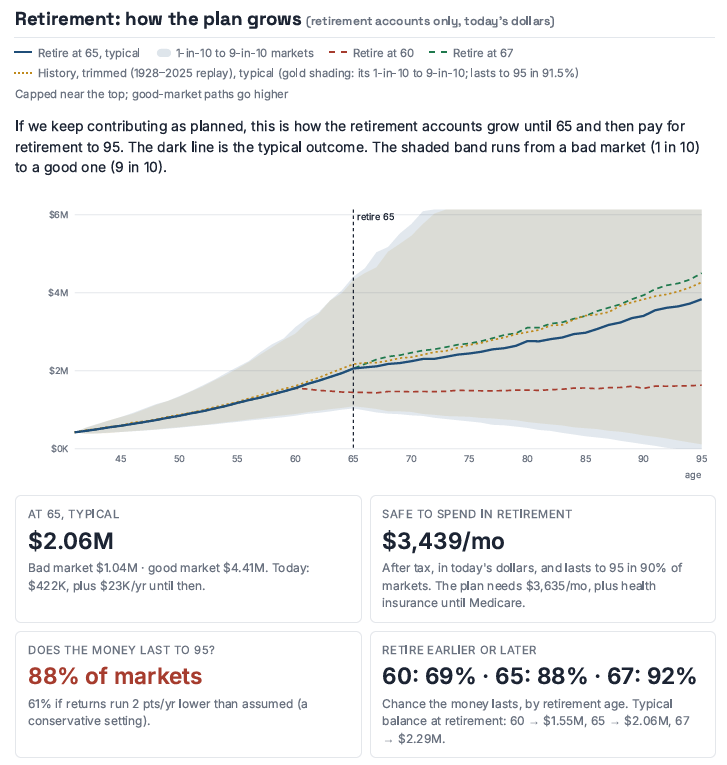
It changes how you price a goal, too. Each one is valued in today's dollars, discounted at a real rate that matches how certain it has to be. The more essential the goal, the lower the rate, and the more it costs today. A lifetime of everyday spending is priced like a bond you can't default on. A dream cabin is priced like the risk it is.
Short goals get holding rules instead of market odds. The emergency fund stays in cash. A lump-sum goal 3 years out or less is held in cash, a blend up to 7 years, and invested beyond that. Only retirement gets a full simulation.
Then it asks which money is for what. Is the money for the essentials sitting somewhere a bad year can't touch?
And a monthly statement for what already happened
The PFS looks forward. Foliome also got its opposite this week: a monthly statement of activity. It's your household's own bank statement, across every synced account at once.
It's strictly factual. No interview, no assumptions, no projections. Just what happened to the money over a period.
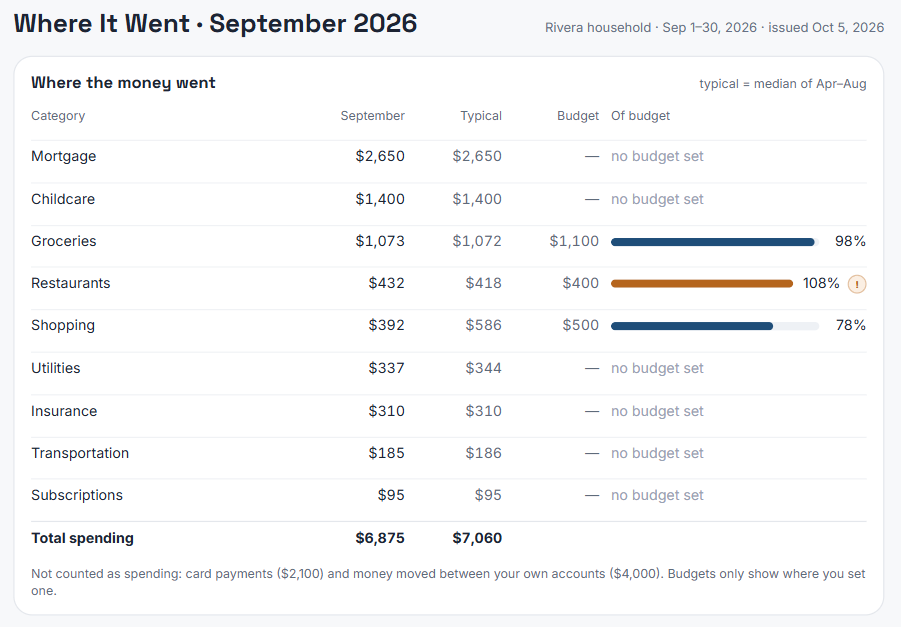
Running it is one ask: /statement, or plain English like "statement for September", "Q3", "since Jan 1". Any period works. If you want one issued automatically every month, schedule it with /foliome-loop on any day from the 1st to the 28th. The 5th is a good default, once late postings settle. Nothing runs on a schedule unless you set it up. You get a short Telegram summary, and the full statement shows up in a new Statements tab in the dashboard with a Download PDF button. There's a sample statement for the demo household.
Why Foliome exists
I built Foliome because I was tired of paying to view my own money through an aggregator that only saw part of it. These two statements are the clearest version of that argument.
A plan needs every source, labeled honestly: synced accounts, numbers you state, assumptions about people and years, live market data. One aggregator connection gives you the first of those. An agent that runs on your machine can hold all four, keep them current, and show its work. Put the PFS next to the monthly statements and you can see whether the plan is on pace. Wiring the monthlies into each quarterly review is next.
Both are optional. Foliome runs fine without them. If you already run Foliome, each is one command: /financial-statement for the PFS and /statement for the monthly.
Foliome is free, open source, and runs on your own machine. To set it up, or to see the sample statements for the demo household, start at the repo: github.com/wnstnb/foliome.