Open Weights, Datacenter Bill: What It Costs to Run Kimi K3.1 Yourself

Moonshot AI's Kimi K3.1 Pro is the strongest open-weight model announced so far, and nothing that fits under a desk runs it for less than renting it. Moonshot released it on October 23 and promised the downloadable weights by Nov 4, 2026 (Kimi). If you've wanted to own a frontier-class model instead of paying per token, this release is the test.
In my 24/7 cost model, four 512GB Mac Studios running K3.1 cost about 1.8 to 2.9 times what the same tokens cost on Moonshot's API, which charges $2 per million tokens read and $10 per million written. A rented server with eight Nvidia B300 GPUs, the smallest box that holds the model, beats that API only if it writes about 2,100 tokens a second around the clock. One person typing at it never gets close.
This is the third post in a series. In February I priced a ten-card RTX 5090 cluster against the API and called it a passion project. Last week one Mac Studio running DeepSeek V4.1 Flash came within about 10% of its own API in the same cost model. K3.1 sits at the top of the open-weight table, and it breaks that trend.
What is Kimi K3.1 Pro, and why is it so hard to host?
K3.1 is a mixture-of-experts model. It has 2.8 trillion parameters in total, but each token only passes through about 104 billion of them, the experts the model picks for that token (Artificial Analysis). That keeps it quick to compute, but all 2.8 trillion parameters still have to sit in memory, because any token can call on any expert.
On quality it holds up. Artificial Analysis, an independent benchmarking firm, ranks it fourth of 215 models on its Intelligence Index, which rolls many benchmark tests into one score. It scores 55, three points behind the leader, Claude Opus 5.5. Most of the other benchmark numbers in Moonshot's launch post are Moonshot's own, so I'm leaning on the independent ones.
One caveat runs through this whole post. The weights aren't out yet. Every hardware number below is carried over from Kimi K3, which Moonshot released in July with the same architecture. The license isn't published either, so I'm using K3's terms as a guide. If the Nov 4 files come in smaller or the license comes in looser, the math moves, and I'll redo it.
The date itself looks solid but not certain. K3 launched July 16 and its weights shipped July 27, the day Moonshot had promised (NYU Shanghai RITS). This time China's October 16 draft export controls add a wrinkle. They cover models with 2 trillion or more parameters (Taipei Times), and exempt only technology that has already entered the public domain through open source or publication (Geopolitechs). K3.1 is 2.8 trillion and not public yet. Nobody has said whether that touches the release.
How much memory does Kimi K3.1 need?
About 1.56TB just to load it, going by K3. K3 shipped as 96 files totalling 1.56TB, stored in MXFP4, a 4-bit number format Moonshot trained the model to use from the start (Spheron). The serving software vLLM plans for 1,680GB of GPU memory once you add working room for the conversation in progress (Kingy).
That rules out most hardware people own.
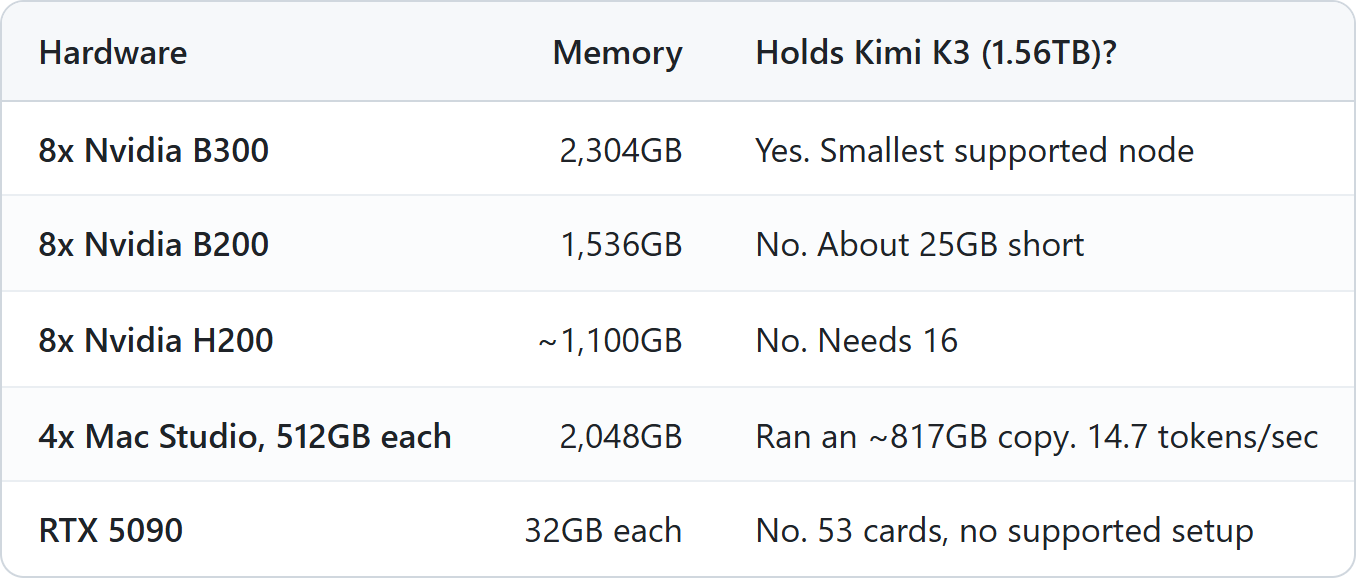
Moonshot's own advice is bigger still. For production it recommends a supernode of 64 or more accelerators (Northflank).
There's one way under that floor: community copies with the numbers rounded down to fewer bits. I also found reported K3 files at 594GB and 466GB, and I'm not using them. The 594GB file is exactly the size of an older Kimi model, K2 Thinking, which makes me think someone mislabeled it. Any shrunk copy also gives up some quality, and nobody has measured how much for K3.1.
A warning while you're shopping: a Hugging Face repo named penclaw-Kimi-K3.1-pro-unrestricted promises the weights early, gates its files behind an email sign-up, and shows nothing to download.
Four Mac Studios: the desk-sized option
The best published local result for K3 is Alex Ziskind's cluster of four 512GB Mac Studios wired together over Thunderbolt 5, running Apple's MLX framework. MindStudio wrote it up: a shrunk copy of K3 at about 817GB on disk, about 14.7 tokens a second when writing and about 238 a second when reading the prompt (MindStudio).
Fourteen tokens a second is slower than most people read. It works for a job nobody is watching.
The price is the soft part. Apple hasn't priced the 512GB M5 Ultra Mac Studio, which is due late October (Macworld), so the cluster MindStudio wrote up almost certainly ran the older M3 Ultra. The last 512GB M3 Ultra cost $9,499, and MindStudio puts each Mac at about $16,000. Four of them run between $38,000 and $64,000.
"if you spend $120.000 on hardware you can run a single super slow thread of kimi 3.1 pro at home." @thekitze, Oct 2026
He's high on the price. He's right about the single thread. Nobody has published multi-user numbers for a Mac cluster on K3, and last week's DeepSeek tests showed one Mac gaining little from extra users.
Do four Mac Studios break even against the Kimi K3.1 API?
No. I ran the same model as last week's post, built to give local hardware its best shot:
- Workload: a 24/7 agent loop. Every call reads 8,192 tokens and writes 1,000, back to back with no idle time.
- Depreciation: 36 months, straight line, nothing left at the end.
- Power: Apple's stated peak of 300W per M5 Ultra Mac Studio, the box you'd buy today (Apple ML Research), around the clock at 18.2 cents per kWh, the EIA's 2026 US residential average (EIA).
- API price: Moonshot's list price of $2 in and $10 out per million tokens, with no cache discounts (Artificial Analysis).
Each call takes about 102 seconds: 34 to read the 8,192-token prompt and 68 to write 1,000 tokens. That's about 25,700 calls a month, or 210 million tokens in and 26 million out. On the API those tokens cost about $677.
Owning the cluster costs $1,055 to $1,778 a month in depreciation, plus about $159 in power. Call it $1,215 to $1,937.
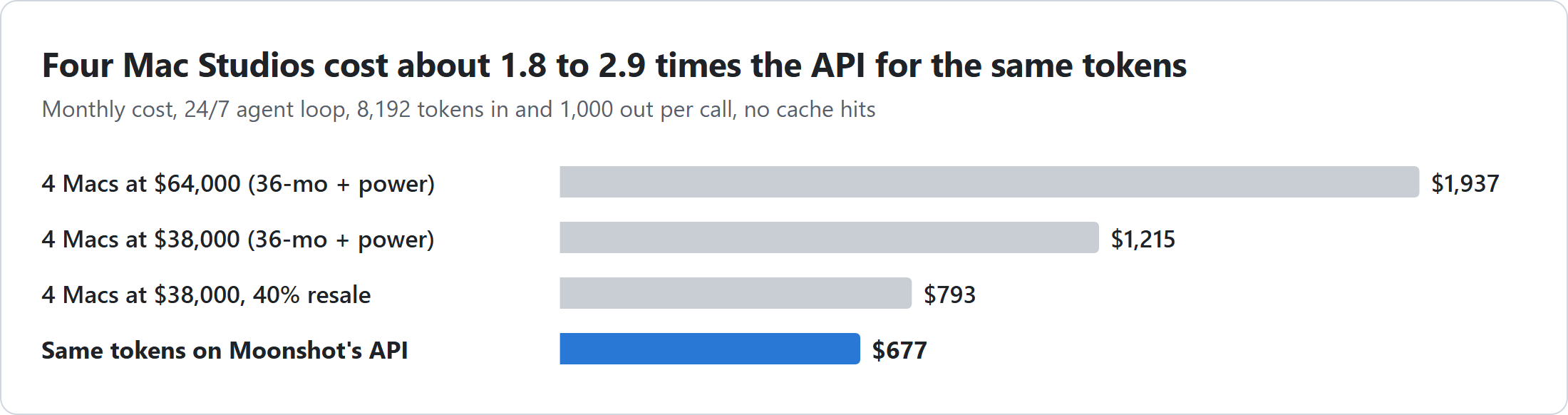
I tried to rescue it. If the Macs resell for 40% of their price after three years, the cheap end drops to about $793 a month. That still loses to $677. Faster chips are the other way out. At the low price the cluster would need to run about 1.8 times faster to break even, and at MindStudio's price about 2.9 times.
Caching widens the gap. Moonshot charges $0.20 per million input tokens on a cache hit, a tenth of the normal rate. An agent that resends the same system prompt and tool list on every call gets that discount on a big share of what it reads. If half of the 210 million input tokens hit the cache, the API bill falls to about $488.
Last week's DeepSeek Mac held about 150 to 200GB of model in memory. This K3 cluster held about 800GB. A model four to five times bigger needs four Macs instead of one, and the hardware bill grows with it.
What does an 8x B300 node cost to run Kimi K3.1?
About $76 an hour, and it only pays off under heavy, steady traffic. An 8x B300 server has 2,304GB of GPU memory and batches well, which means it serves many requests at once and spreads its cost across all of them. The Mac cluster mostly can't.
Nebius, a GPU cloud, raised its B300 price to $9.50 per GPU-hour on October 1 (UsagePricing). Eight of them make $76 an hour, or $55,480 a month. Planning quotes for the whole node run from $59 to $142 an hour (Kingy).
At $76 an hour, counting only the $10 output price, the node breaks even at about 2,100 output tokens a second, every hour of the month. Picture roughly 42 users each getting a comfortable 50 tokens a second, nonstop. At the cheapest and priciest node quotes the line moves to about 1,600 and 3,900. Counting input tokens too would lower it, but reading prompts also takes GPU time, so I kept the simple version.
What you pay per token depends almost entirely on how busy you keep the node.
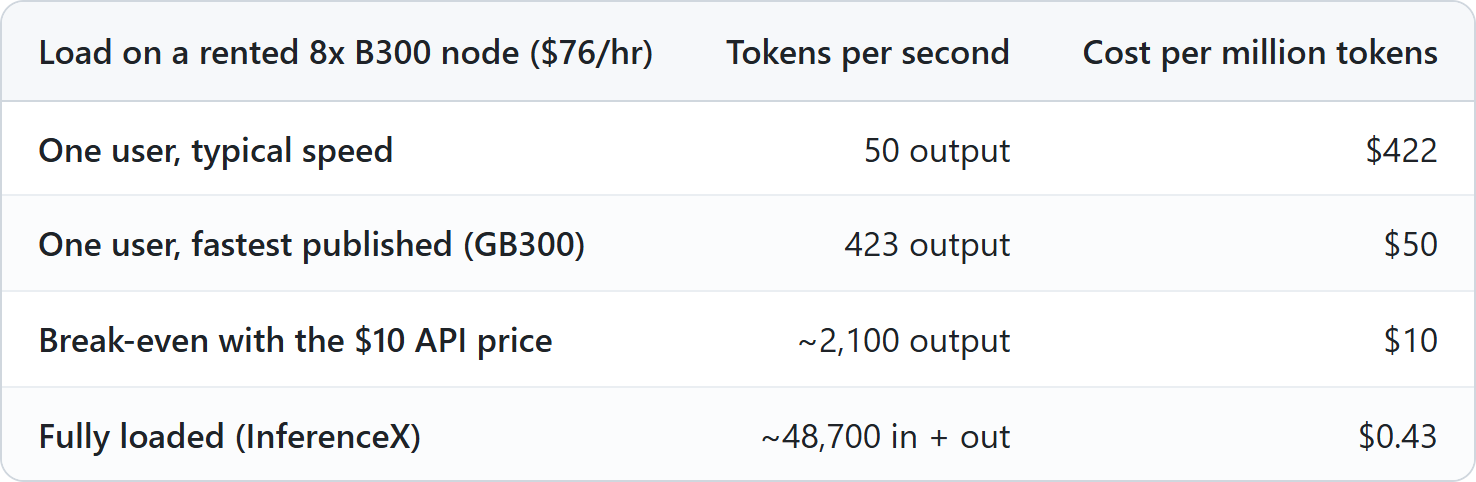
The bottom row comes from SemiAnalysis's InferenceX benchmark, which measured about 6,083 tokens a second per B300 on a K3 agentic-coding workload, with each user getting 50 tokens a second (InferenceX). That counts input and output together. Even so, $0.43 sits far under the $10 API price.
The second row is the best case for one person. LMSYS got K3 to about 423 tokens a second for a single request using speculative decoding, where a small draft model guesses ahead and the big model checks its guesses (LMSYS). That ran on GB300, the B300's sibling in Nvidia's rack systems. Even at that speed, a single user pays about five times the API rate.
Buying instead of renting is a different scale of decision. AMCompute's October tracker puts a new HGX B300 8-GPU server at $400,000 to $450,000 (AMCompute), before power, cooling and a rack to put it in.
Who does self-hosting Kimi K3.1 actually pay off for?
The break-even line describes a company. Forty-odd streams around the clock is an internal coding platform, a product with real users, or a host reselling the model.
For everyone short of that line, open weights pay off through other people's servers:
- Competing hosts. Once the weights ship, any cloud can serve K3.1 and price it against Moonshot's own API.
- Data that can't leave the building. A bank or hospital that can't send prompts to a Chinese API can run the same model in its own datacenter, on hardware it already has budget for.
- Fine-tuning and distillation. You can adapt the model, or train smaller ones from it, subject to the license.
Cheaper hosts also move the break-even line. Every price cut on the API side raises the traffic a self-hosted node needs to beat it, and pushes the 2,100-tokens-a-second line higher for everyone below host scale.
The license decides how much of that competition happens. K3's terms required a separate agreement with Moonshot for any business serving the model as a service with more than $20 million in revenue over 12 months, and products with over 100 million monthly users had to display "Kimi K3" (Digital Applied). Internal deployments were exempt. If K3.1 follows K3, small hosts compete freely and the biggest ones negotiate.
The open end of the market also keeps stretching. In February a 1.4GB model ran on a Raspberry Pi. Now the top of the open table is a 1.56TB download. Both count as open weights. For the bigger one, open mostly means you get to pick whose datacenter runs it.
What to check when the weights land
Three things settle this math: the real checkpoint size, the first vLLM and MLX speed numbers, and the license text. Until they're out, price your own traffic against the 2,100-tokens-a-second line before you buy anything.