The AI Displacement Report Card: What the Data Actually Shows
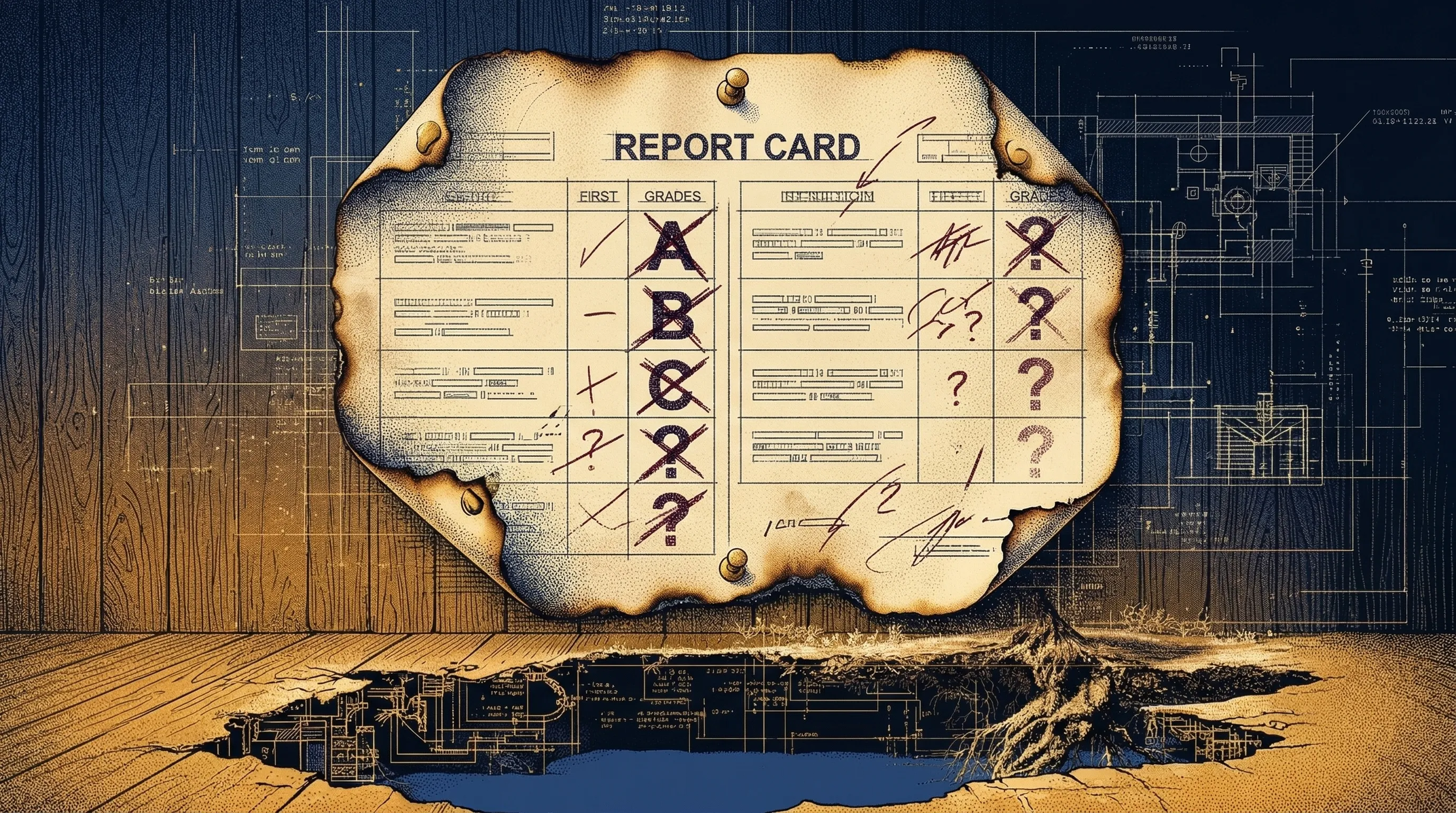
The World Economic Forum predicted 85 million jobs displaced by AI by 2025. That was a global number. We are now past that deadline. The actual figure for the US alone is somewhere between 200K and 300K. Even accounting for the scope difference, the global displacement number is nowhere near 85 million. The predictions missed by an order of magnitude at minimum.
This is not a defense of AI. It is a report card. The predictions failed. The narrative failed. And the actual forces reshaping the labor market are hiding behind a story that is more convenient than it is true.
The Prediction Track Record
Geoffrey Hinton predicted in 2016 that radiologists would be replaced by AI within five years. A decade later, zero radiologists have lost their jobs to AI. Radiology AI tools are widely deployed. They help radiologists read more scans faster. The job didn't vanish. The workflow absorbed the tool.
Mustafa Suleyman, Microsoft's AI chief, said most professional work would be automated within 18 months. That was early 2025. We are past the halfway point. Total US employment is up 2.5% since ChatGPT launched.
Gartner predicted that 20% of organizations would eliminate more than half their middle management positions by 2026. The Conference Board's data shows no such pattern in realized layoff filings.
The pattern: aggressive predictions from people with either research grants tied to AI importance or products to sell. Followed by reality that moves slower than the forecast by an order of magnitude.
What's Actually Driving Job Losses
If AI isn't the primary engine of displacement, what is? The honest answer requires looking at six forces operating simultaneously. None of them are as marketable as the AI narrative.
The Oil Shock
The Strait of Hormuz effectively closed in early March 2026. Brent crude blew past $120. Gas prices jumped 30% in a month. Diesel topped $5 for the first time since 2022. Every supply chain on the planet is repricing. Every company that moves physical goods is recalculating margins. This is not an AI problem. This is a geopolitical shock hitting operating costs directly.
The Tariff Regime
Yale's Budget Lab projects that current tariffs will eliminate 550,000 US jobs by the end of 2026. The 25% tariffs on imports from Canada, Mexico, and China amount to roughly $1,500 in additional costs per American household. Companies are not laying off because AI replaced the work. They are laying off because input costs spiked and margins compressed.
The DOGE Cuts
Over 350,000 workers left the federal payroll since January 2025. The largest peacetime workforce reduction on record. Virginia alone lost 23,500 civilian federal jobs. One-third of displaced federal workers who found new jobs had to relocate. This is a policy decision, not a technology outcome.
The Post-Pandemic Overcorrection
The tech industry hired aggressively in 2021 and 2022, then spent 2023 through 2026 unwinding those headcount expansions. AI accounts for only 4.5% of total reported job losses tracked through early 2026, according to Oxford Economics. The other 95% have different causes. The real driver is financial engineering: companies that overhired during the zero-interest-rate era are correcting against a backdrop of elevated borrowing costs.
The Frozen Fed
The Fed held rates at 3.5-3.75% on March 18, signaling at most one cut this year. Inflation is re-accelerating from oil and tariffs. The labor market is weakening simultaneously. The Fed is stuck. Companies that need cheaper credit to hire or expand are not getting it. This constraint has nothing to do with AI capability.
Consumer Confidence Collapse
The Conference Board's Expectations Index dropped to 65.1, well below the 80 threshold that has historically signaled a recession within 6-12 months. People are not spending because gas is expensive, groceries cost more, and the news cycle is relentless. Businesses respond to declining demand by cutting headcount. The cause is economic anxiety, not automation.
The AI Washing Problem
So why does every headline say AI?
Because it sounds better.
A Harvard Business Review study surveyed 1,006 executives who cited AI as a factor in workforce reductions. 60% were cutting headcount in anticipation of AI capabilities that hadn't materialized. Only 2% had measured actual AI performance replacing specific roles before making the decision.
A separate survey of hiring managers found that 60% emphasize AI's role in layoffs because it is viewed more favorably than admitting to financial constraints. Restructuring around AI sounds visionary. Admitting your revenue missed targets sounds like failure.
New York State's WARN Act requires companies to provide legally binding reasons for mass layoffs. Of 160 companies that filed, zero checked the box for technological innovation. When there are legal consequences for the explanation, AI vanishes.
The Klarna case is instructive. The company reduced its workforce by 40% between 2022 and 2024, loudly attributing the cuts to AI replacing customer service roles. Then they quietly rehired about 20 customer service staff because, as the CEO acknowledged, the quality dropped. The AI narrative served its PR purpose. The operational reality was different.
Atlassian cut 1,600 positions and simultaneously hired 800 AI-focused roles. Net reduction: 800. That is not displacement. That is skill reshaping with a layoff attached.
What the Payroll Data Actually Says
The Bureau of Labor Statistics shows total US employment rose approximately 2.5% since ChatGPT's release in November 2022. That is millions of net new jobs during the same period AI was supposedly automating everything.
But the aggregate masks an important demographic split. The Dallas Federal Reserve found that young workers under 25 experienced disproportionate job losses in AI-exposed sectors, while older workers' employment remained stable and their wages actually grew faster. Computer systems design sector wages rose 16.7% against a 7.5% national average.
Harvard Business School research found that automation-prone roles declined 13% after ChatGPT launched, but augmentation-prone roles grew 20% during the same period. The net effect is positive. The composition shifted.
The economy lost 92,000 jobs in February 2026, missing estimates by 142,000. But the job losses concentrated in sectors hit by tariffs, energy costs, and federal spending cuts, not in the sectors most exposed to AI automation.
Year-over-year job growth collapsed from 1.2 million to 400,000. That slowdown tracks perfectly with tariff implementation timelines, oil price movements, and the Fed's rate posture. It does not track with AI deployment milestones.
The Adoption Gap Nobody Mentions
Here is the number that should end every AI displacement argument before it starts: 78% of companies say they use AI. Only 1% have mature, scaled deployments delivering real value.
More than half of companies that adopted AI tools report no measurable value from them. 62% are experimenting with AI agents. Only 23% are scaling them. The pilot-to-production chasm is enormous, and it is not closing as fast as the prediction models assumed.
80% of employees report strong AI-related anxiety. 44% believe AI is making them less capable. The middle management layer that would need to redesign workflows around AI tools mostly doesn't know how. The result is AI layered on top of existing processes, producing marginal gains at best.
AI deployment is hard. It requires clean data, redesigned processes, willing employees, capable managers, and often regulatory clearance. None of these move at the speed of a press release.
The Honest Report Card
| Prediction | Source | Verdict |
|---|---|---|
| 85M jobs displaced by 2025 (global) | WEF (2020) | Deadline passed. US: 200K-300K. Global: nowhere close |
| Radiologists replaced within 5 years | Hinton (2016) | Zero lost after 10 years |
| Most professional work automated in 18 months | Suleyman (2025) | Total employment up 2.5% |
| 50% of middle management eliminated | Gartner | No evidence in filing data |
| 50% of entry-level white-collar work disrupted | Amodei | Entry-level hiring down, but from overcorrection + tariffs + oil, not proven AI performance |
The direction of travel is correct. AI will automate significant chunks of white-collar work. The capability is real. The deployment is slow. And the timeline is measured in years, not months.
What is happening right now, in March 2026, is a labor market being squeezed by oil prices, tariffs, federal cuts, a frozen Fed, and collapsed consumer confidence. AI is the story being told about it. That story is more flattering to executives and more frightening to workers than the mundane reality of macroeconomic headwinds.
The displacement will come. But when it does, it will look like the Atlassian pattern: skill reshaping, not mass unemployment. Fewer content creators, more AI engineers. Fewer junior analysts, more senior analysts who know how to direct AI tools. The net effect will be compositional, not catastrophic.
If you are making career decisions right now, make them based on the actual forces operating on the market, not the narrative.
I wrote about what that looks like in practice in The Consultant-to-Builder Pipeline. The short version: the opportunity isn't in learning AI. It's in finding a $1,000 problem in your domain and solving it with AI tools. The displacement data says you have more time than the headlines suggest. The experience premium data says your domain expertise is the asset, not the liability. Use both.