Search API Pricing in 2026: Search Didn't Collapse Like Tokens. It Split.

Token prices fell about 10x a year. Search prices didn't follow. They split into three tiers, and the middle tier barely moved. Exa's base price even went up.
As of October 2026, web search APIs cost between $0.75 and $14 per 1,000 requests, depending on who you buy it from. A new low tier sits at $0.75 to $1 (DeepSeek Search, Perplexity Fast Search, Parallel). The mainstream band held at $4 to $8 (Exa, Brave, Tavily, You.com), and Exa's base search price went from $5 to $7 in March, with page text now included. The search tools bundled with model APIs cost the most: $10 at OpenAI and Anthropic, $14 for Gemini grounding.
I have a personal stake in this one. In February I ripped Exa out of a Raspberry Pi device and replaced it with self-hosted SearXNG. It was free. Eight months later, I can see that free was borrowed.
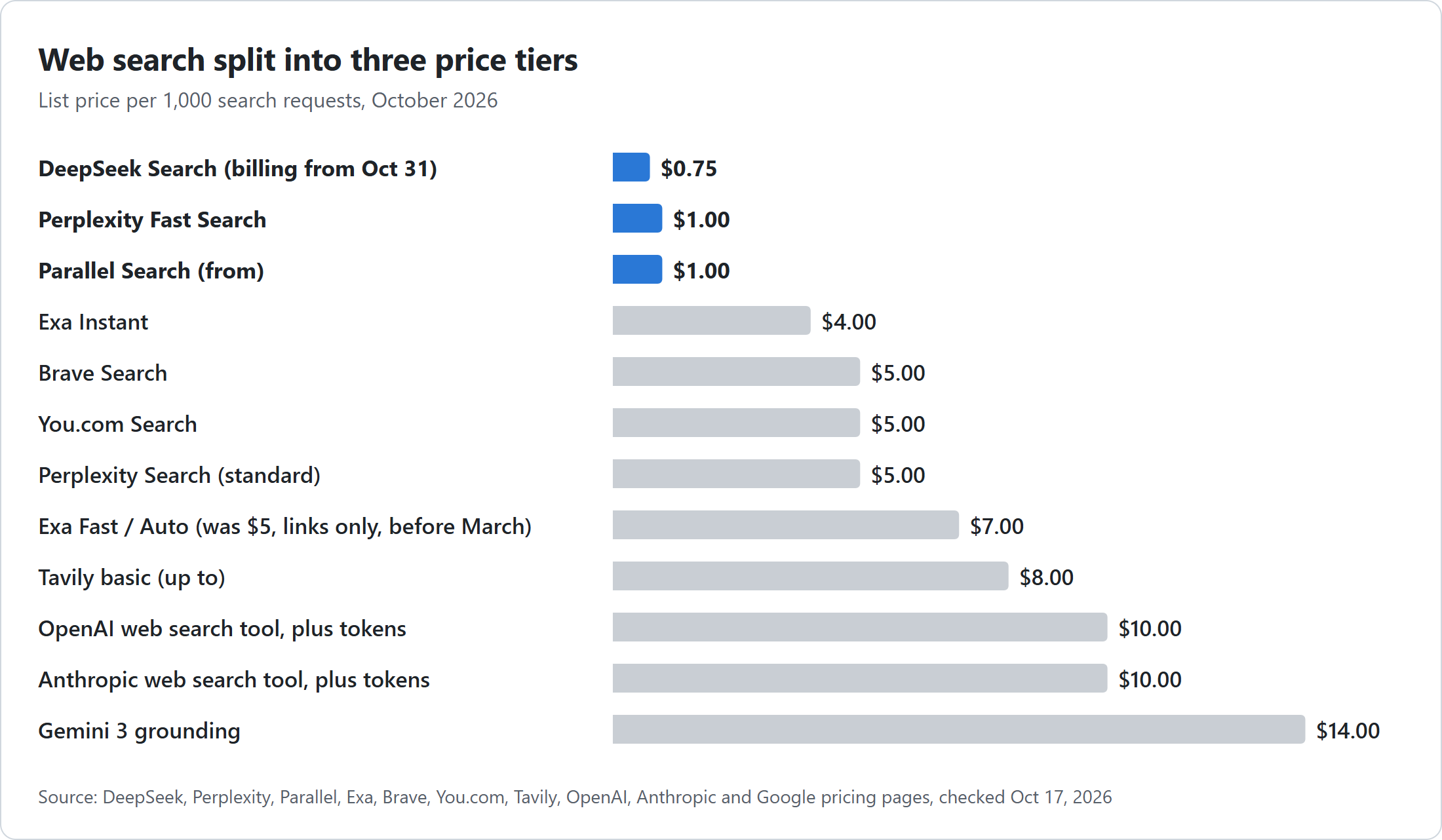
What a web search API costs in October 2026
The cheapest tier is the newest. DeepSeek opened Search and Fetch APIs on October 17 at $0.75 per 1,000 successful calls per endpoint, running on its own engine. Search returns links and snippets. Fetch returns one page as Markdown. Perplexity launched Fast Search at $1 per 1,000 on September 28, 80% under its $5 standard tier. Parallel starts at $1, with 5,000 free requests a month.
Worth being clear on DeepSeek. Billing doesn't start until October 31, and the only quality evidence I've found is one practitioner's latency test on X. The price is real. Whether the results hold up at that price is still open.
The middle band barely moved, and parts of it went up:
- Exa charges $4 for Instant and $7 for Fast and Auto. The $7 used to be $5 for links alone. Exa repriced it in March and folded page text into it, so a basic search costs more and a search with contents costs less.
- Brave charges $5 and dropped its free tier for new users in February.
- Tavily's basic search runs $5 to $8 depending on plan, with $8 the pay-as-you-go rate. You.com and Linkup sit at $5 to $6.
The top tier is the convenient one. OpenAI's web search tool and Anthropic's both charge $10 per 1,000 searches plus the tokens for whatever comes back. Gemini 3 grounding, where the model runs its own Google searches to back its answer, is $14 per 1,000 queries after 5,000 free a month. I couldn't confirm current prices for Azure's Grounding with Bing or Vertex AI grounding on their own pages, so they're left out.
That's a nearly 19x spread for roughly the same job: send a query, get back ten links and some text. A spread that wide means the price is tracking something other than the cost of the lookup.
Why search prices didn't fall like token prices
Inference gets cheaper because hardware and distillation get better. a16z measured the price of GPT-3-level output falling from $60 to $0.06 per million tokens between November 2021 and November 2024. That's the curve everyone expected search to ride.
An index doesn't ride it. It has to be re-crawled all the time, and the open web is getting harder to crawl:
- Since September 15, 2026, Cloudflare blocks AI crawlers by default on ad-supported pages for new and free-tier accounts, if those crawlers won't separate search, agent, and training use. It's also moving publishers toward Pay Per Use, which pays them when their content gets used.
- Common Crawl's monthly snapshot shrank 29%, from 3.03 billion pages in early 2025 to about 2.14 billion in mid-2026. Common Crawl doesn't give a cause. The drop fits a web that blocks more bots.
- The raw compute is cheap. One engineer crawled about a billion pages in roughly a day for $462. The money goes to bot defenses, page rendering, proxies, and keeping it all fresh.
So the lookup gets cheaper while access to the pages gets more expensive. Put those two forces together and you get a split. My guess for the next year: query prices keep sliding toward the low tier, while fresh page content stays the expensive part to supply.
The cheap tier comes from companies that already run an index for some other product. DeepSeek has a consumer chat app. Perplexity has an answer engine. They built the index for themselves and are selling API access on top of it, close to marginal cost. It's a restaurant selling its kitchen's extra capacity as takeout. The kitchen was getting paid for anyway.
DeepSeek's changelog says its engine handles a lot:
"reliably handles hundreds of millions of search requests from around the world every day"
DeepSeek API updates, October 2026
That's self-reported, and most of it is probably consumer traffic. But it explains the price. An API customer at $0.75 is riding infrastructure that exists for a different reason.
The middle tier has no second product to absorb its index costs. Exa, Brave, and Tavily sell search as the product. Their price has to cover the crawl, which is why it held while tokens fell 1,000x. And the crawl keeps growing. Exa says the URLs it tracks nearly tripled between May and August, to 1.4 trillion.
What happened to our self-hosted SearXNG stack
In February I swapped Exa for SearXNG plus trafilatura on a Pi. The numbers were fine: about 4 seconds for the first query, 2 to 3 seconds after that, around 200 MB of RAM, and no per-call fee. The same SearXNG backend still powers the search agent in my Content Studio app.
What I didn't think hard about then: SearXNG has no index of its own. It relays. Every result it returned came from Google, DuckDuckGo, Brave, or Wikipedia. The Pi did the asking. Someone else did the searching.
I called it fully local. It was local the way a phone is local. The call still goes out.
The upstreams that made the relay free were already closing when I built it, and they've kept closing since:
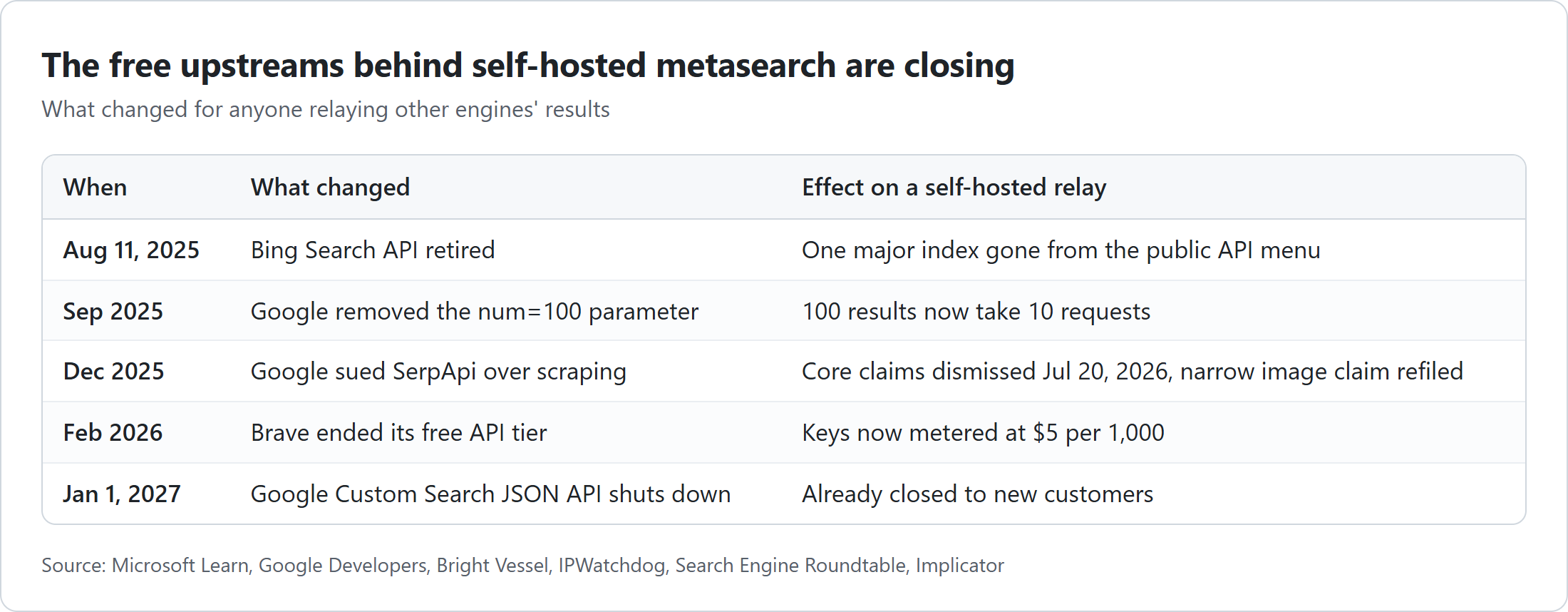
People who run SearXNG at real volume keep naming the same cost. From a July 2026 Hacker News thread, a five-year self-hoster:
"From time to time you get blocked on the duckduckgo, brave or whatever search and you must solve some captures. You can prevent this by getting and using API-Keys from them"
Hacker News commenter, July 2026
Paying for API keys to dodge captchas turns free self-hosting into a paid middleman, and Brave's keys now cost $5 per 1,000. The original Searx author showed up in the same thread to say he's no longer involved "due to the limitations of the metasearch concept" and is building a full-text indexer instead.
That's the honest version of my February post. Self-hosted search mostly meant scraping someone else's index, and the doors to those indexes are closing one API at a time.
Fetch still works. Pulling the text out of a page you already have a link to is commodity code. trafilatura is free. Anthropic's web fetch tool has no per-call fee, only tokens. DeepSeek charges the same $0.75 for Fetch as for Search.
Search fee vs token cost: the fee is now the bigger bill
On a cheap model, the search fee now costs more than reading the results.
Take a small model at $0.10 per million input tokens, the price point Claude Haiku 5.5 and GPT-6 Luna sit at. Price one search in tokens:
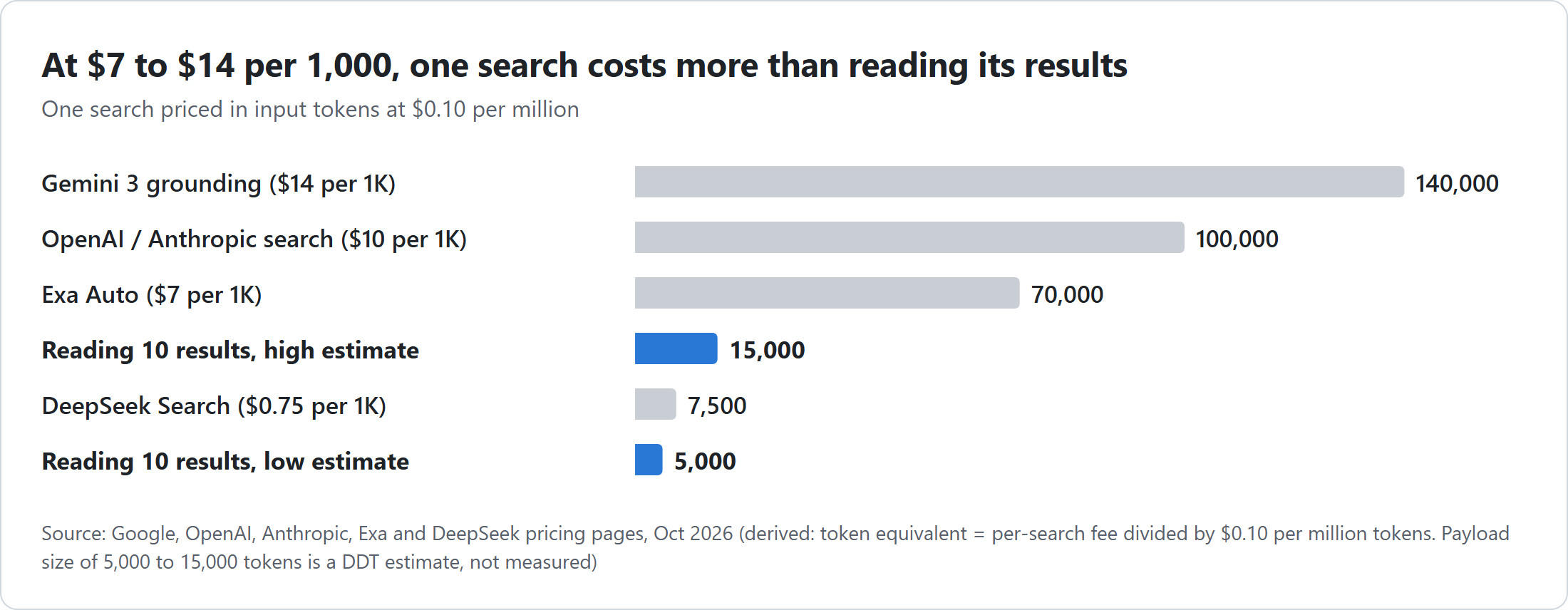
Ten results with page contents usually run 5,000 to 15,000 tokens. That's my estimate. I haven't measured it. On that estimate, a $10 bundled search costs 7 to 20 times what the model pays to read what it returned.
Run the same math the other way. Reading those results costs roughly $0.50 to $1.50 per 1,000 searches on a $0.10 model. So above about $1.50 per 1,000, the search fee is the bigger line item. Below about $0.50, reading wins. In between, it depends on how much each result carries. That crossover is my arithmetic on an assumed payload size, so treat it as a range.
Picture this from inside an agent. You're running a research loop on the cheapest model you can find, because the per-token bill is what you were told to watch. Each run makes 10 or more searches through the vendor's built-in tool. The model is the cheap part of that run now.
Walk one deep research run through it. Google doesn't publish how many searches its Deep Research agent makes, but one vendor guide puts it at 80 to 160. At $10 per 1,000, that run spends $0.80 to $1.60 on search alone. At DeepSeek's $0.75, the same run spends 6 to 12 cents.
Two caveats. On a $4 per million frontier model, reading the results still costs more than the search. And Anthropic bills search result content as input tokens on every later turn of the conversation. In a long loop, a search keeps costing you after it runs unless you summarize or drop the results.
What Exa's $100M says about agent search volume
Exa says it passed $100M in annualized revenue on October 13. CEO Will Bryk put the growth rate this way:
"We've grown almost exactly 10x per year for 3 years."
@WilliamBryk, October 13, 2026
Paul Graham's reply: "to keep it up for 3 years is close to unheard of. That's 1000x."
Exa also says it serves 2 billion requests a month. Both numbers are self-reported. Dividing one by the other is my arithmetic: $100M over 24 billion requests a year is about $4.17 per 1,000. That's the bottom of Exa's own $4 to $7 list range.
Now run the same 24 billion requests at DeepSeek's $0.75. That's $18M a year. The gap between $18M and $100M is the premium the market currently pays for retrieval quality and index coverage, and it's what DeepSeek's price puts on the table.
DeepSeek isn't close to taking it yet. Three limits keep it out of Exa's customer base for now:
- 5 queries per second per account. That caps one account at about 432,000 calls a day, or 13 million a month, against Exa's 2 billion. Fine for one builder. Matching Exa's volume would take about 150 accounts.
- 128-character queries. Bryk's pitch is that agents write long, complex queries. DeepSeek's cap rules out exactly those.
- Jurisdiction. Queries go to a Chinese provider. That rules it out for a lot of enterprise and regulated work, which keeps the middle tier in business.
If DeepSeek lifts the rate and length caps, the first two limits shrink fast. The third one doesn't. Expect the middle tier to compete on what DeepSeek can't offer a regulated buyer: long queries, volume, and a contract their compliance team will sign.
A developer who runs on Tavily put the trade-off plainly, in Chinese. In translation: DeepSeek's endpoints are fairly basic next to Tavily's aggregation and extraction layers, but about 7 to 10 times cheaper (@GuangzhouY81070, October 2026).
Server-side search calls made through DeepSeek's own harness, Claude Code, and Codex are free until October 31. That puts DeepSeek search inside coding agents before anyone has paid for a single call.
How to buy web search for an AI agent now
Here's the rule I'm working from.
- Buy the query, build the fetch. At $0.75 to $1 per 1,000, a million searches a month costs $750 to $1,000. That doesn't justify running your own index, and a metasearch relay only ever borrowed someone else's. Fetch is where self-hosting still saves money. One catch: DeepSeek Fetch fails on heavy JavaScript sites, and a local fetcher hits the same wall. So do Cloudflare's new crawler blocks. Your own fetcher is still a bot to them.
- Skip the bundled tool on a cheap model. At $10 to $14 per 1,000, the vendor's built-in search is the most expensive way to ground a $0.10 model. An external $1 API plus your own fetch costs about a tenth as much.
- Pay the middle tier for a quality reason you can name. Exa's semantic retrieval and its 80-billion-page index (Exa's own number) are real reasons. Tavily's extraction layer is a real reason. Habit isn't. At 5 to 10 times the low tier, you should be able to say what you're buying.
- Self-host for privacy. The Pi device keeps SearXNG because it needs no API key and no account with a search vendor, which fits the privacy promise I built it around. The cost argument for self-hosting stopped holding once $0.75 showed up and the free upstreams started closing.
Tokens are a hardware business, and hardware gets cheaper every year. Search is an access business, and access gets priced by whoever owns the door.
So which door is your agent paying for?
On a $0.10 model making 100 searches a run, that's the difference between 7.5 cents and $1.