The Opt-In List: What Microsoft's Buyout Says About Which Jobs Are Safe

On October 26, Microsoft offered a voluntary buyout to about 60,000 employees, roughly 27% of its 223,000-person workforce. A buyout is a payment to leave by choice: take the package, give up the job. Microsoft didn't offer it to everyone, and the list of teams it skipped is the most useful career data a big tech company has revealed this year.
The offer went to product organizations like Xbox, Windows, Copilot and Finance. Sales, marketing and security were left out, and the teams that run Microsoft's data centers were reportedly left out too. The sort follows how close a job sits to revenue or to physical capacity. Whether the job is AI work barely shows up in it, since several of Microsoft's own AI product groups were on the offer list.
What Microsoft's buyout memo says, and what it leaves out
The memo came from Amy Coleman, Microsoft's chief people officer. It introduces a Voluntary Exit Offer for "eligible employees in participating teams in Canada, India, the United Kingdom and the United States at level 70 and below." Level 70 is high on Microsoft's internal ladder. By the common read of that ladder, it reaches into director and partner-level roles, well above the senior-director cap on Microsoft's spring program.
The memo names no teams. It says this instead:
"Some organizations are providing the Voluntary Exit Offer, and some are not. Participation varies based on each business's priorities, customer commitments and workforce needs."
Amy Coleman, Microsoft, Oct 26 2026
Each business leader decided whether their org was in. So the participation list is a set of choices, made by the people closest to each budget, about where Microsoft can afford to lose people.
The package itself is ordinary. A Microsoft spokesperson told KUOW it is "comparable to the company's standard severance package," with base pay tied to tenure, stock, health care and career planning services. Employees decide by early December and leave on December 31, per CNBC.
Which Microsoft teams got the buyout offer
Microsoft hasn't published the list. What exists comes from three layers of sourcing, and they don't carry equal weight.
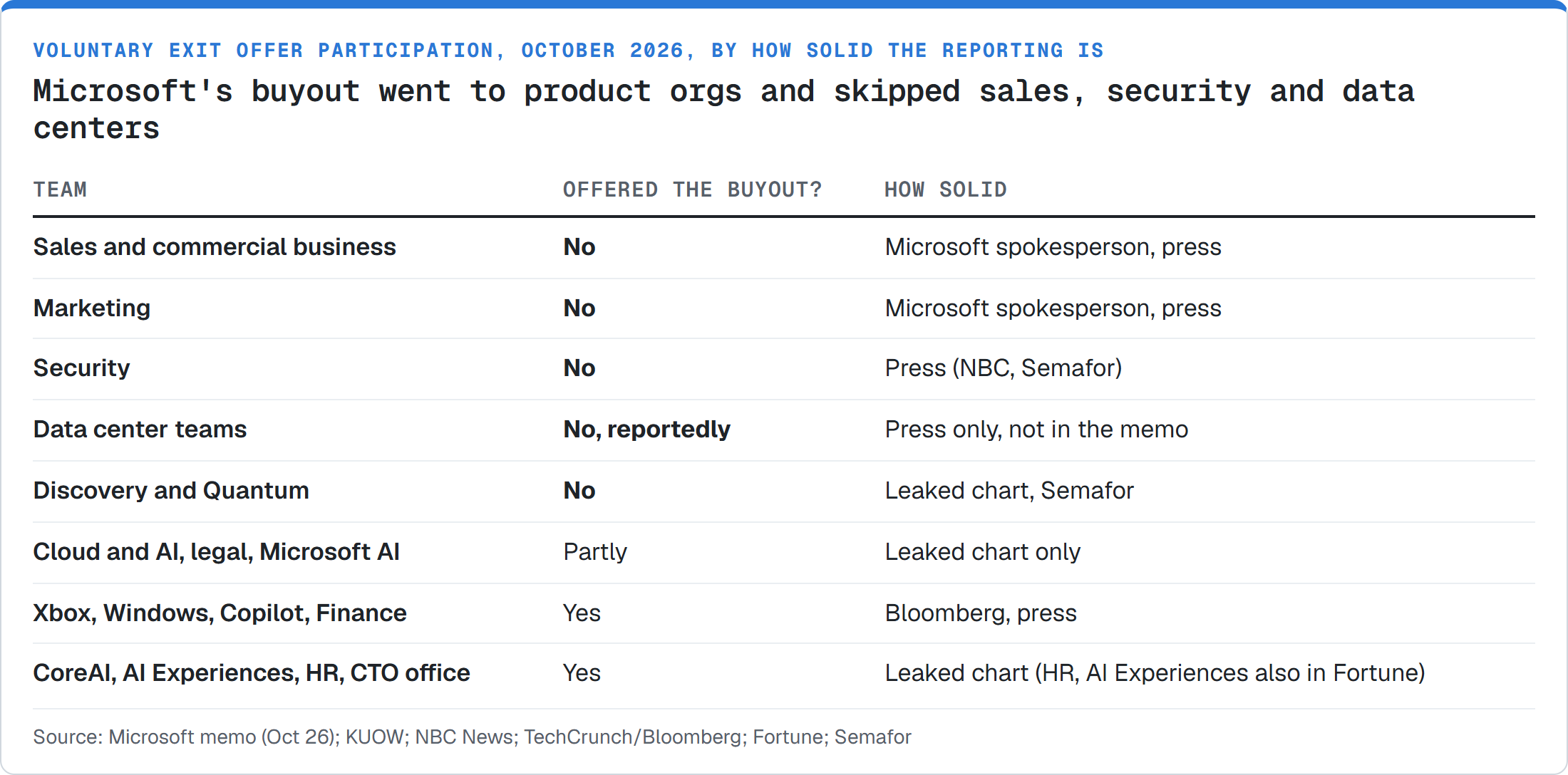
The solid layer comes from a Microsoft spokesperson and major outlets. The spokesperson told KUOW that "the sales organization, some corporate services like marketing, and some engineering teams will not be participating." NBC News reported that "units such as marketing, commercial business and security will be excluded." Bloomberg's reporting, via TechCrunch, put Xbox, Windows, Copilot and Finance on the offer side.
The data center piece is shakier. TechCrunch and Semafor both reported that data center teams were kept out. None of that is in the memo, and the reports likely trace back to one or two original sources. A participation chart that leaked on X lists Cloud and AI, the group where data center operations sit, as only partly participating. I haven't seen the chart itself, only descriptions of it, and parts of it match the press reports. So I'm treating the data center exclusion as reported, with that caveat attached.
Why AI work doesn't predict who Microsoft protected
My first pass at this list sorted it the way most career advice does: AI jobs versus everything else. That sort fell apart on the first row. Copilot is on the offer list. So, per the leaked chart, are CoreAI and AI Experiences, groups building Microsoft's AI products. If AI work were the shield, those would be the most protected teams at the company.
The second sort fit almost every row. It asks how many steps a team sits from a signed customer or a running server.
- Sales and marketing turn capacity into revenue. They're one step from the contract.
- Data center teams build and run the capacity Microsoft is spending record sums on. They were reportedly protected.
- Security keeps a failure from turning into a loss. A breach costs money and customers within days.
- Product orgs, Finance and HR sit a step or two further back. Their headcount is a cost line a leader can trim without a customer noticing this quarter.
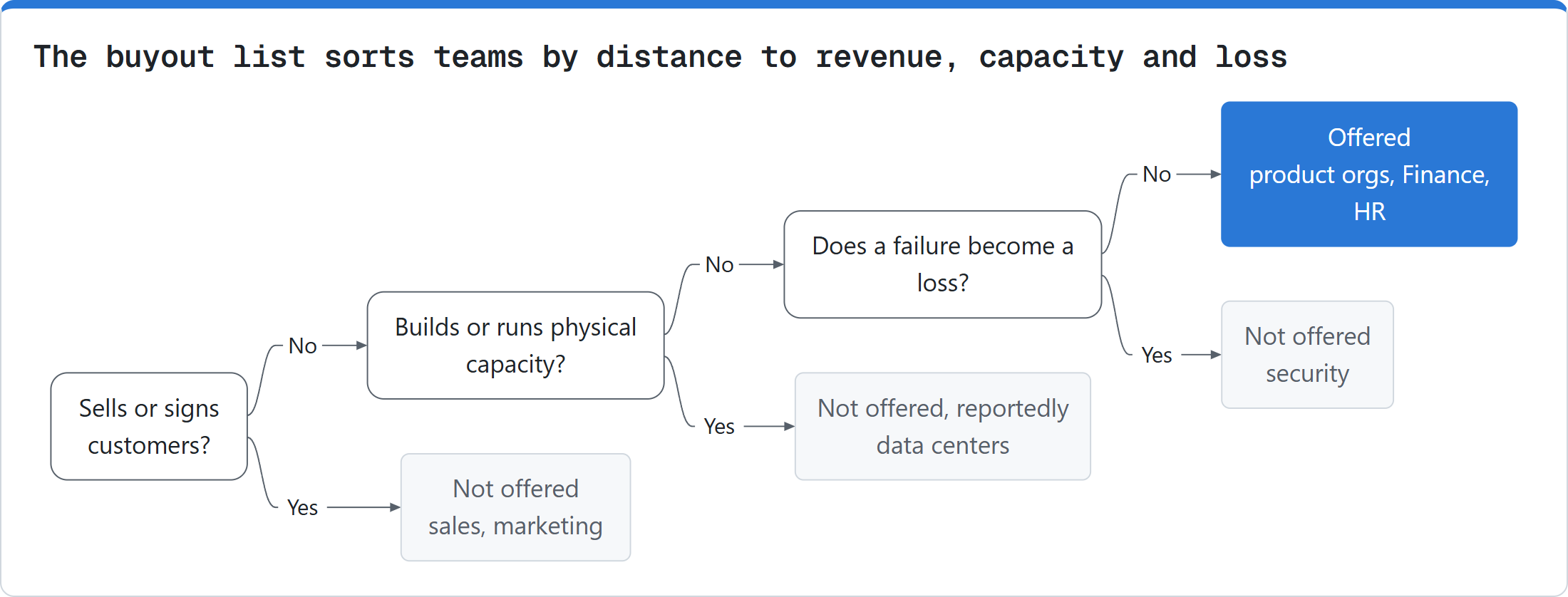
One row doesn't fit cleanly. Discovery and Quantum was reportedly kept out of the offer too, and quantum computing is years from revenue. My read is that it's a small research bench that would be hard to rehire, protected as a long bet. It's the exception to keep in mind before treating the sort as a law.
The money behind the sort: Microsoft's capex math
Capex, short for capital expenditures, is what a company spends on long-lived assets like data centers and chips. Microsoft's capex explains why the sort looks the way it does.
Two days after the memo, Microsoft reported its September quarter. Cash spent on property and equipment was $39.37 billion, about double the $19.39 billion a year earlier, per its October 28 filing. Spread over the quarter's 92 days, that's about $428 million a day, by my arithmetic. CFO Amy Hood told analysts that for the calendar year, "spend should be approximately $170 billion" (Microsoft investor relations).
Now the payroll side. A TIKR model estimates that if 10% of eligible staff took the offer, Microsoft would save about $1.9 billion a year, which works out to roughly $317,000 per person by my arithmetic. That's about four and a half days of capex. A Microsoft spokesperson told Fortune "we anticipate an under 5% uptake," which would leave the saving below $1 billion a year.
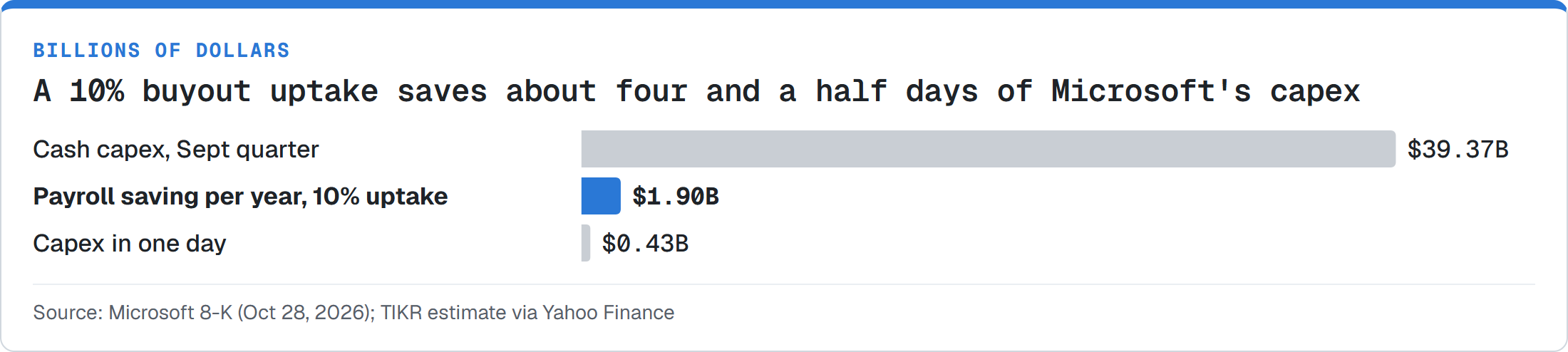
So the buyout can't pay for the data centers. What it does is shrink payroll, a cost that comes back every year, while the capex shows up later as depreciation spread over the life of the servers and buildings. On the earnings call, the program got one sentence: "Our cost guidance across both COGS and OpEx includes an estimate for the recently announced employee voluntary exit offer." COGS is the cost of delivering Microsoft's products and services, and OpEx is everything else it spends to run the company. No dollar figure came with it.
When a company is pouring money into hardware, the people who build, run, sell and secure that hardware are what the spending is for. Most other work becomes overhead the CFO is trying to hold flat. Boston University economist Jay Zagorsky told Fortune that "all of the biggest tech companies are shifting towards more capital by building expensive AI data centers and [relying on] less labor." I wrote about the middle-management side of this squeeze back in April.
Why the best people take a buyout first
A flat-price buyout has a known flaw. Economists call it adverse selection: when everyone eligible gets the same offer, the people with the best outside options are the most likely to take it. They can land another job fast, so the package is close to pure upside for them.
The World Bank's labor toolkit on severance programs says it plainly:
"Voluntary separations in exchange for severance pay create an adverse selection problem, whereby the best workers leave... and the worst workers stay."
The toolkit's standard fix is to limit who can apply, through "selection by cadre, location, or operating unit." Microsoft's org-by-org opt-in is that fix, applied to business units. It keeps the offer away from teams leaders can't afford to thin. Inside a participating org, it does nothing. The toolkit's Sri Lanka case found that "even where workers of an identified tier were subject to voluntary retirement... the better workers within the tier opted to leave."
Price matters too. Microsoft's spring program, its first voluntary retirement offer in 51 years, went to about 8,750 US employees with up to 39 weeks of pay and up to five years of health care. More than 30% took it, per Bloomberg via TechCrunch. The fall offer is standard severance, and Microsoft expects under 5%. The two groups aren't identical, since the spring offer targeted people near retirement, but the gap is wide enough that price likely explains most of it. Verizon's 2018 program, which offered up to 60 weeks of salary, drew about 10,400 of 44,000 eligible managers, or roughly 24% (Verizon 2018 annual report). A study of University of California faculty buyouts by economist John Pencavel found that "an individual presented with 10 percent higher severance benefits has a 7-8 percent higher probability of quitting" (Pencavel, 2001).
Hacker News had the practitioner version on day one:
"My former boss at Microsoft told me this sort of thing is a good way to get rid of your best, most employable employees."
christophilus, Hacker News, Oct 26 2026
If you're in a participating org and you're the person your manager would least like to lose, you're also the person this offer appeals to most.
What being left off the buyout list doesn't protect
Being left off the list protects you from this offer and nothing else. About 4,800 layoffs followed the spring program in July, per CNBC. Hood said in April that fiscal 2027 headcount would come down again. And the memo leaves room for change, since participation depends on "each business's priorities," which move.
Google has run the same play. It offered voluntary exit programs at least three times between June 2025 and February 2026, reportedly keeping large customer sales teams out (Business Standard). Two of the largest tech employers drew the same line around sales, which makes me more confident the sort isn't just Microsoft's internal politics. In 13 years in financial services, I've seen budget reviews draw the line in the same place: the people who bring in revenue and the risk teams regulators expect go last, and shared services go first.
The wider tally points the same way. AI was cited for 120,136 announced US job cuts through September, the top reason given in 2026, per Challenger, Gray and Christmas (via InsiderOne). Buyouts like Microsoft's don't show up in counts like that unless the company reports them as cuts. An opt-in list is one of the few public views of where the cuts are landing.
How to score your own job against the opt-in list
The employee's side of this is a hard bet. One Hacker News commenter laid it out:
"Do you accept, take the money, and hope you can find a job (Now competing with many other Msft employees that are looking). Do you decline and hope you don't get hit with the layoff"
ecshafer, Hacker News, Oct 26 2026
The list gives you a way to price that bet. Run the same three questions Microsoft's org leaders seem to have run, in order.
- How many steps sit between your work and a signed customer? Sales is one. A platform team serving the product team that serves the customer is three.
- Do you build, run or depend on the physical capacity your company is buying? When capex is growing, those jobs grow with it.
- If your work stopped for a month, would it show up as a loss, an outage or a missed deal? Security answers yes within hours. Most internal tooling answers maybe, next quarter.
If you're at Microsoft in a participating org, the decision is due in early December. Run the three questions on your team before you run the package math. If two of the three answers are no, plan as if the next round looks at your team too.